About Acacia macradenia Benth.
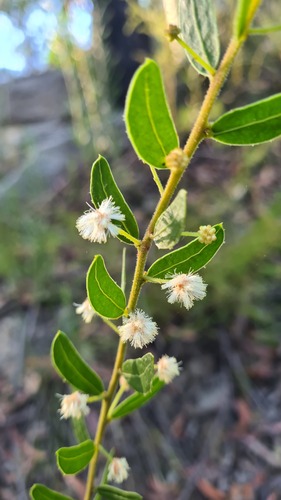
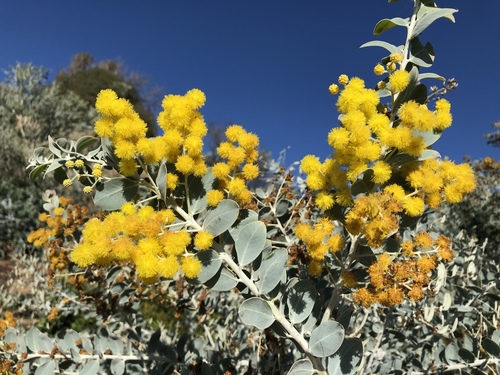
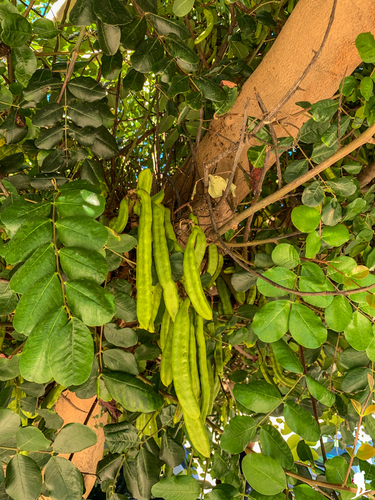
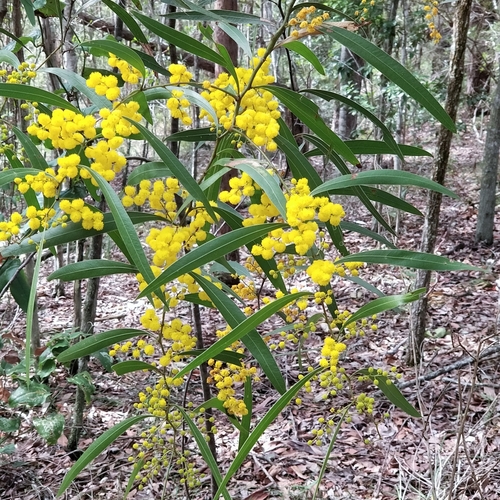
Acacia macradenia Benth. has hairless, smooth branches. Generally, younger stem sections are green, while older stem sections are brown. Its leaf-like structures, called phyllodes, are actually flattened petioles (leaf stalks); true leaves are initially bipinnate. Older phyllodes are darker, longer, and lanceolate in shape, while younger phyllodes are much smaller. This plant or tree can grow up to 5 meters tall, with a spread of up to 4 meters. Its branches are pendulous (loosely hanging) to subpendulous and flexuose (readily bending). Small, yellow, globular flower clusters grow at stem stalks. Each cluster holds between 35 and 50 individual flowers; each flower has five petals, five sepals, and many stamens, which give full-bloomed clusters a soft appearance. Flower cluster development depends on weather, with optimal flowering occurring at temperatures from February through March. Developing flower clusters show visible red areas when they start growing; if no flower clusters form, existing phyllodes continue to grow in an alternating pattern. The fruits are black pods, which give the species its common name zig-zag wattle. These pods are small, curved, have a smooth outer casing, and have a structure similar to a lima bean. Pods start out green, then turn brown-black as temperatures rise through spring, until they reach full maturation. Fully mature pods can grow up to 12 centimeters long. Inside the pods are hard, brown, bean-shaped seeds. One experiment testing how temperature affects Acacia macradenia seed germination found that seeds treated with hot water had higher germination rates than seeds treated with cooler water. This species is native to Australia, where it occurs naturally across Central Queensland, and is cultivated in regions around Chinchilla and Pentland. Due to its invasive growth habit, it has also been recorded growing outside its native range in places such as Ipswich parks. Acacia macradenia is a shrub that grows best in cool to warm climates, in sandy or gravelly areas near creeks. Cold temperatures prepare seeds and enhance stronger flowering when temperatures rise again. Experiments testing tolerance have found this species can adapt to air-polluted areas: seeds grown in environments with different concentrations of air pollution maintained stable photosynthetic and transpiration rates, similar to rates seen in non-polluted environments. For cultivation, Acacia macradenia prefers a well-drained position and full sun. It has been successfully cultivated in coastal areas of eastern Australia, from Townsville south to Melbourne. However, plants have died from heavy frosts in some inland locations, including Canberra.