About Acacia longifolia (Andrews) Willd.
Scientific name: Acacia longifolia (Andrews) Willd.
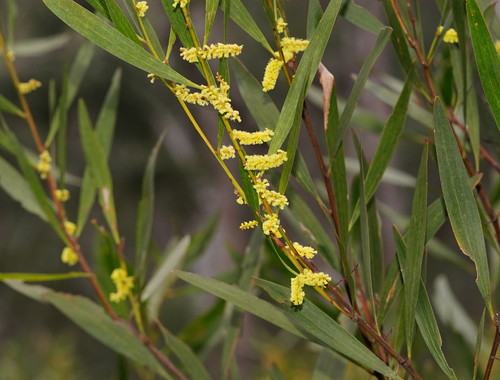
Description Golden wattle grows as either a shrub or a tree, reaching a maximum height of 8 m (26 ft). It has smooth to finely fissured greyish bark, and glabrous angled branchlets that become more pronounced toward their apices. Like most Acacia species, it has phyllodes rather than true leaves. These evergreen, glabrous phyllodes are mostly straight, occasionally slightly curved, measure 4 to 20 cm (1.6 to 7.9 in) long and 4 to 30 mm (0.16 to 1.18 in) wide, and feature numerous prominent longitudinal veins.
Within its native range, it blooms between June and October, producing simple inflorescences that occur singly or in pairs in phyllode axils, on stalks less than 2 mm (0.079 in) long. The cylindrical flower-spikes are 2 to 4.5 cm (0.79 to 1.77 in) long, densely packed with bright to pale yellow flowers. After flowering, thinly leathery to firmly papery seed pods develop; these are straight to strongly twisted, swollen above each seed and constricted between individual seeds. The pods are usually 4 to 15 cm (1.6 to 5.9 in) long and 2.5 to 6 mm (0.098 to 0.236 in) wide, and become reasonably brittle when dry.
Distribution This species is endemic to coastal south-eastern Queensland, near the Queensland-New South Wales border, with its native range extending south along the New South Wales coast. In New South Wales, it is common in tablelands and coastal areas, found in a range of habitats including foredunes, and is usually a component of sclerophyll woodland or coastal heath and scrub communities.
Its range extends further south and east through Victoria into South Australia, where it occurs on the Eyre Peninsula, Yorke Peninsula, Kangaroo Island, southern Mount Lofty Ranges, and throughout the south-eastern region, where it is mostly restricted to sand dunes. The subspecies A. sophorae grows in sand dunes along Tasmania's coastline. It has become naturalised in coastal areas of south-western Western Australia, ranging from around Perth in the north to around Albany in the south; it is thought to have naturalized after escaping cultivation or from use in revegetation plantings. Recommended control methods for the species outside its native range include hand pulling seedlings, ringbarking, or cutting the plant down and painting the cut stump with glyphosate.
Uses Acacia longifolia is widely cultivated in subtropical regions worldwide. Its uses include prevention of soil erosion; as food (flowers, seeds, and seed pods); as a source of yellow dye from flowers, and green dye from pods; and for timber. The yellow flower colour comes from the organic compound kaempferol. The tree's bark has limited use in tanning, primarily for sheepskin. It is useful for stabilizing uninhabited coastal sand deposits, mainly in areas that do not experience frequent hard frosts. In Tasmania, Indigenous people traditionally roasted ripening pods, removed the seeds and ate them.
Cultivation Despite having weed potential outside its native range, this shrub is available commercially and can be propagated via seed scarification or treatment with boiling water. It is considered an attractive, hardy, fast-growing species suitable for use as a hedge or for privacy screening. It is well-suited for hydroseeding work on banks to provide soil stabilization. Sydney golden wattle adapts well to low-maintenance areas such as road embankments, grows in a wide range of soil types, and is frost hardy. It is currently heavily used as a street canopy tree in Southern California, because it grows fairly quickly (reaching 5 meters in height within one to two years after planting), tolerates drought, and survives even the harsh pruning practices common to low-cost tree services. In Portugal, the species is considered highly invasive in sand dunes, and its cultivation is prohibited by law.