About Acacia lanigera A.Cunn.
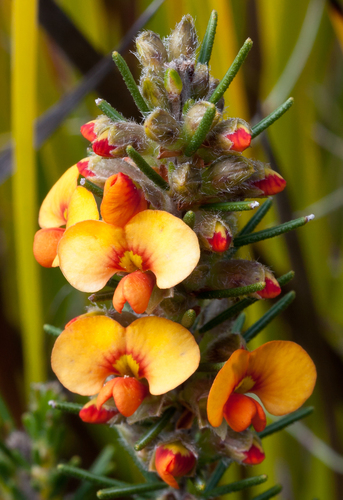
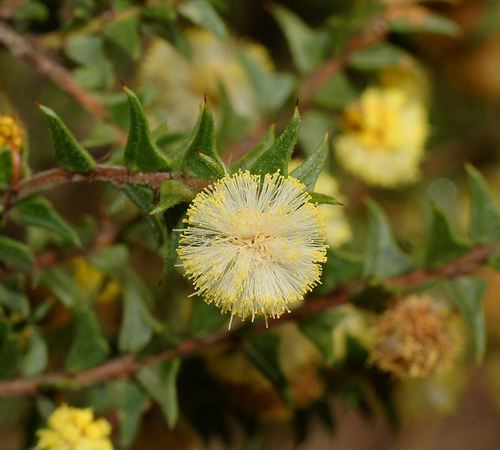
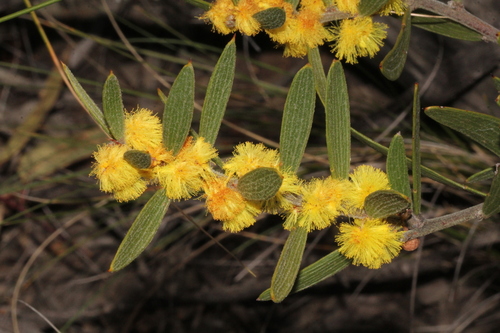
Acacia lanigera A.Cunn. has an erect or spreading growth habit, reaching up to 2 meters (6 feet 7 inches) in height. Its phyllodes may be either hairy or glabrous, and measure 20 to 70 millimeters (0.79 to 2.76 inches) long by 2 to 8 millimeters (0.079 to 0.315 inches) wide. Bright yellow, globular flowerheads grow in the leaf axils from May through October. After flowering, it produces curved or coiled seedpods that are densely covered in white hairs, reaching up to 10 centimeters (3.9 inches) in length.
This species is naturally distributed in New South Wales, Victoria, and the Australian Capital Territory. It was first formally described by botanist Allan Cunningham in 1825, in the publication Geographical Memoirs on New South Wales; Cunningham originally noted it as "a shrub frequent on rocky barren ranges in the interior".
In cultivation, Acacia lanigera prefers a well-drained, sunny growing position, and can tolerate frosts as cold as −7 degrees Celsius. It adapts well to planting in locations that require only infrequent maintenance, such as road batters.