About Acacia implexa Benth.
Scientific name: Acacia implexa Benth.
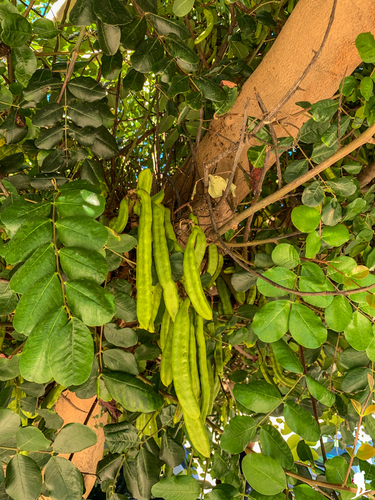
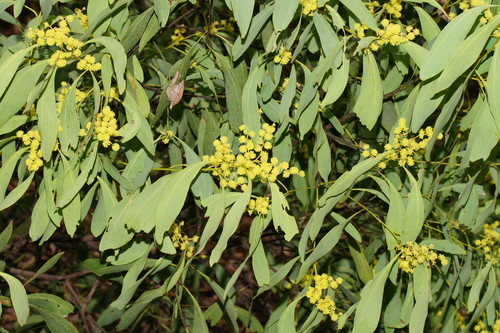
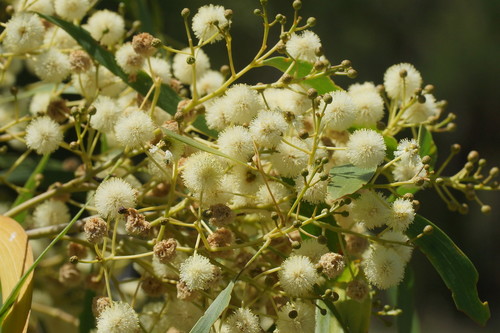
Description: Acacia implexa is a long-lived small to medium-sized tree with an upright growth habit and an open crown. It typically reaches 5–15 m (16–49 ft) in height and 4–10 m (13–33 ft) in width. The tree can grow with either a single stem or multiple stems, and has rough greyish bark. Branchlets are commonly lightly covered in a waxy bloom, and do not have prominent ribs. It has light green, slender, sickle-shaped phyllodes that grow up to 20 cm (7.9 in) long and 6–25 mm (0.24–0.98 in) wide. The phyllodes have 3 to 7 prominent parallel nerves, plus many other fainter parallel branching nerves. Bipinnate leaves may remain on some plants, and young growth can be purple under certain conditions. It blooms in summer, producing spherical, strongly scented cream-coloured flower heads. Each flower head is 5–6 mm (0.20–0.24 in) in diameter, and holds 30 to 52 cream to pale yellow individual flowers. After flowering, it forms thick woody seed pods that are linear in shape, twisted to coiled, up to 25 cm (9.8 in) long and 4–7 mm (0.16–0.28 in) wide. Dust from these pods is an irritant to the eyes and nose. The wood of Acacia implexa is similar to that of Acacia melanoxylon, so the two species are often mistaken for one another.
Distribution: Acacia implexa is widespread across eastern Australia, ranging from central coastal Queensland to southern Victoria. There are outlying populations on the Atherton Tableland in northern Queensland, and on King Island, Tasmania. It is commonly found on fertile plains and in hilly country, where it usually grows as part of open forest communities in shallow, dry sandy and clay soils.
Aboriginal uses: The Ngunnawal people of the Australian Capital Territory used this species' bark to make rope, string, medicine and fish poison; its timber for tools; and its seeds to make flour. The Dharawal people used the flowering of Acacia implexa as a seasonal indicator: they do not light campfires unless on sand, and avoid camping near creeks and rivers when this tree blooms. The Wiradjuri people of New South Wales use its seeds to make flour, and its bark as medicine and for fish poison.
Cultivation: For Acacia implexa seeds to germinate, they must first be scarified to crack the hard outer seed casing. Germination typically occurs within two weeks after scarification and planting in suitable soil. This species is very hardy, and is well suited for soil stabilization and bank planting, because it has a suckering growth habit that becomes more active if roots are damaged. It grows well in full sun, is drought tolerant, and tolerates frosts down to −7 °C (19 °F). It is very prone to leaf gall.