About Acacia howittii F.Muell.
Growth Habit
Acacia howittii F.Muell. is a shrub or tree with an erect or spreading growth habit, growing up to 9 m (30 ft) high.
Branchlet Characteristics
It has pendulous, slender branchlets with pubescent ribs.
Phyllode Presence
Like most Acacia species, it has phyllodes rather than true leaves.
Phyllode Morphology
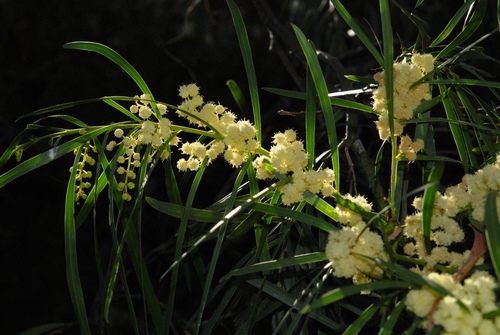
The thin, dark green phyllodes are up to 2 cm (0.79 in) long and 4 to 8 mm (0.16 to 0.31 in) wide, with a narrowly elliptic to lanceolate shape and two to three distinct nerves per face.
Flowering Period
The globular pale-yellow flowerheads appear in leaf axils in October in Australia.
Inflorescence and Flowers
Simple inflorescences occur singly or in pairs in the axils, with spherical flower-heads containing 12 to 20 pale to lemon yellow flowers.
Seed Pod Development
After flowering, straight seed pods form that grow up to 6 cm (2.4 in) long.
Seed Pod Characteristics
These firmly chartaceous to thinly coriaceous brown seed pods have a narrowly oblong to linear shape 4 to 5 mm (0.16 to 0.20 in) wide, are mostly glabrous, and have hairy margins.
Seed Arrangement
The seeds inside are arranged longitudinally.
Seed Morphology
The shiny dark brown oblong seeds are 3 to 4 mm (0.12 to 0.16 in) long, with a terminal aril.
Native Distribution and Habitat
This species is native to eastern Victoria, Australia, ranging from the upper reaches of the Macalister River near Mount Howitt in the north, south to around Yarram, and east to around Tabberabbera, where it usually grows in moist forest environments.
Conservation and Cultivation Status
Although it is considered a rare species, it is commonly cultivated and has become naturalised in areas outside its original range.