About Acacia heterophylla (Lam.) Willd.
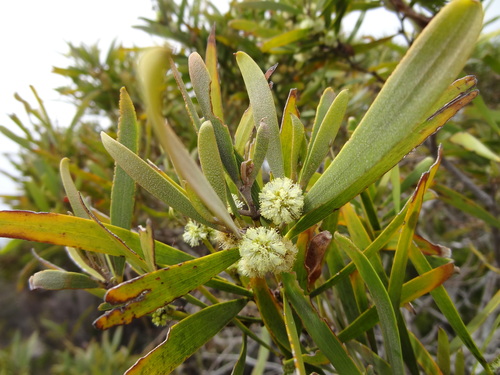
Acacia heterophylla, commonly known as the highland tamarind, is a tree that grows as a shrub at higher elevations. It is endemic to Réunion Island, where it is locally called tamarin des hauts. This species goes through a distinct juvenile growth stage, during which its leaves are arranged in a pinnate pattern. In the adult stage, true leaves reduce in size, and phyllodes become the main photosynthetic structure. Acacia heterophylla has been introduced to Madagascar, where it grows in a subhumid climate at altitudes between roughly 500 and 1000 meters above sea level. Genetic sequence analysis has confirmed that the closest relative of Acacia heterophylla is Acacia koa, which is native to Hawaii. The two species are estimated to have diverged approximately 1.4 million years ago. Genetic sequences of A. heterophylla are nested within the more genetically diverse sequences of A. koa, which makes A. koa a paraphyletic species. Both species descend from an ancestral species originating in Australia, which is presumed to be their sister species, Acacia melanoxylon. Since the seeds of these species are not adapted for prolonged immersion in seawater, it is thought that seeds were dispersed to Hawaii first, then to Réunion by birds such as petrels; the dispersal journey from Hawaii to Réunion covers a distance of 18,000 km. Acacia heterophylla and A. koa also occupy very similar ecological niches, which differ from the ecological niche of A. melanoxylon.