About Acacia harpophylla F.Muell. ex Benth.
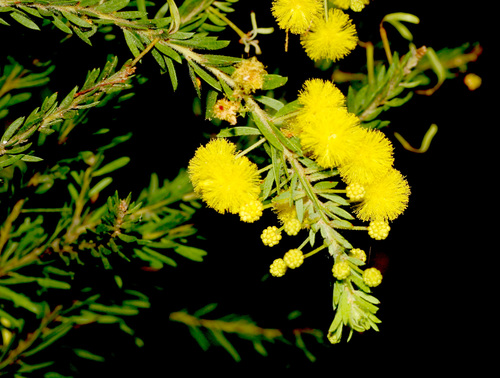
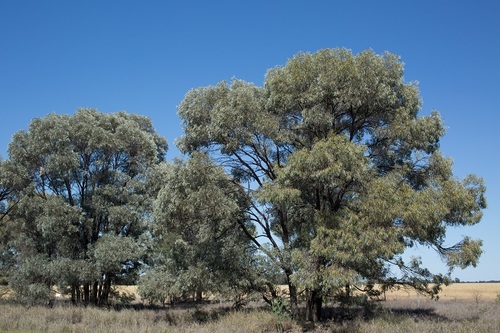
Acacia harpophylla F.Muell. ex Benth., commonly known as brigalow, is a root-suckering tree that can reach heights of up to 20 m. It has hard, furrowed, almost black bark. Its branchlets, which can be either glabrous or hairy, are angular at their tips. Like most Acacia species, it has phyllodes instead of true leaves. These evergreen phyllodes are coriaceous and sericeous, with a curved falcate shape. They measure 10 to 20 cm long and 7 to 20 mm wide, with many closely parallel nerves, of which three to seven are more prominent than the rest. Flowering occurs between July and October, when the tree produces condensed inflorescences. These inflorescences grow in groups of two to eight on racemes, and usually appear as axillary clusters. The spherical flower heads are 5 to 8 mm in diameter, and each holds 15 to 35 golden flowers. After flowering, crustaceous, glabrous seed pods develop. The pods are subterete, ranging from straight to slightly curved, and are raised over and constricted between individual seeds. They can grow up to 20 cm long, 5 to 10 mm wide, and have longitudinal nerves. The seeds inside the pods are soft, dull brown, and arranged longitudinally. They have an oblong or broadly elliptic shape, and are flattened but thick, measuring 10 to 18 mm long, with a filiform funicle. Brigalow, along with gidgee (Acacia cambagei), forms open woodlands on flat to gently undulating terrain with heavy, relatively fertile clay and clay-loam soils. These woodlands are primarily found in Eastern Australia's region that receives 300 to 700 mm of annual rainfall, and extend from a northern extreme at 20° S into northern New South Wales. In some regions, brigalow and gidgee grow together in mixed communities, and are commonly associated with other woody species. Overstorey associates include Eucalyptus coolabah, Eucalyptus cambageana, and Casuarina cristata, alongside a variety of understorey species. Acacia tephrina, Acacia georginae, and Acacia argyrodendron occupy similar habitats and share similar habits and growth forms, but have smaller ranges. A number of other Acacia species also form structurally similar communities. Brigalow occurs across areas receiving from over 900 mm of annual rainfall in coastal regions to semiarid regions with 500 mm of annual rainfall, though it is primarily a species of the semiarid zone. In drier western regions where rainfall is lower, gidgee (A. cambagei) replaces brigalow, and gidgee occurs across areas receiving 300 to 650 mm of annual rainfall. Gidgee reaches a maximum height of around 12 m, making it somewhat smaller than brigalow. In north-western areas, black gidgee (A. argyrodendron) replaces brigalow across many locations. In Central-Western districts, boree (A. tephrina) forms woodlands and shrublands, frequently growing on cracking clay soils, and often found in association with A. cambagei. Georgina gidgee (A. georginae) woodlands occur in more arid regions, within the annual rainfall belt of 200 to 250 mm. Within New South Wales, brigalow is found from around Roto in the south to around Hungerford in the west, and to Willow Tree in the east along the Great Dividing Range. Within Queensland, it occurs as far north as Townsville.