About Acacia floribunda (Vent.) Willd.
Scientific name: Acacia floribunda (Vent.) Willd.
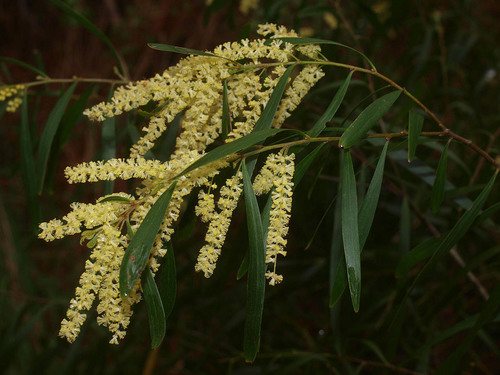
Description: Acacia floribunda is a spreading shrub or tree that typically reaches a height of 2–8 m (6 ft 7 in – 26 ft 3 in). It has smooth grey bark that sometimes becomes rough with age, and pendulous branches that are often covered in soft hairs. Its phyllodes are linear to narrowly lance-shaped, 50–190 mm (2.0–7.5 in) long and 1.5–12 mm (0.059–0.472 in) wide. They are thin, pliable, and have up to three main veins.
Flowers are borne in one or two loosely packed spikes that are 20–80 mm (0.79–3.15 in) long, growing from a very short peduncle. Flowering usually occurs from June to September. After flowering, it produces more or less cylindrical seed pods, which are mostly straight to strongly curved. The pods are 60–120 mm (2.4–4.7 in) long and 2–4 mm (0.079–0.157 in) wide, with a firm papery texture, and are more or less constricted between individual seeds. The seeds themselves are elliptic, 3–5 mm (0.12–0.20 in) long, glossy brown, and have a small aril.
Distribution and habitat: Commonly called white sally wattle, this species is widespread in forests and woodland. Its native range extends from Stanthorpe, Mount Barney and Tambourine Mountain in south-eastern Queensland, through New South Wales, to Briagolong in eastern Victoria, with an isolated native population at Nambour. It grows mainly in coastal sclerophyll plant communities, often in sandy soil, and is common along stream banks. It is naturalised in other areas of Victoria, Tasmania, and possibly the Australian Capital Territory.
Use in horticulture: In landscaping, Acacia floribunda is very useful for erosion control, especially in gullies. It also works well as a hedge or screen plant. It can be propagated from scarified seed, or from seed treated with boiling water.