About Acacia extensa Lindl.
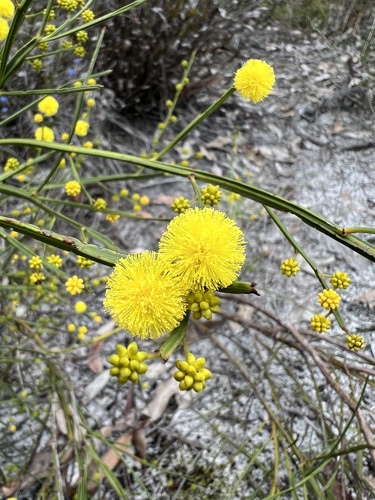
Acacia extensa Lindl., commonly known as wiry wattle, is a spindly, open shrub that usually grows up to 3 metres (9.8 feet) in height. It has angled branchlets that are often flattened at the tips, and are sometimes narrowly winged. Its phyllodes are usually few in number, often thread-like in shape, and resemble the plant’s branchlets. The phyllodes measure 60–240 millimetres (2.4–9.4 inches) long and 0.8–1.8 millimetres (0.031–0.071 inches) wide, with five prominent yellowish veins. Flowers of Acacia extensa grow in spherical heads arranged in racemes that resemble the plant’s branchlets, on peduncles 3–8 millimetres (0.12–0.31 inches) long. Each spherical head contains 12 to 24 light golden yellow flowers. Flowering occurs between August and October. After flowering, the plant produces linear seed pods that are straight to slightly curved, up to 90 millimetres (3.5 inches) long and 3–4 millimetres (0.12–0.16 inches) wide. The pods have a texture ranging from firmly papery to thinly leathery, and look somewhat like a string of beads. The seeds inside the pods are oblong, 4–5 millimetres (0.16–0.20 inches) long, shiny dark brown, and have an aril at one end. This wattle grows in sand and laterite soil within the forest understorey, along watercourses or near lakes and swamps. It is widely distributed across south-western Western Australia, ranging from near Mogumber south to Albany, and occurs within the Esperance Plains, Jarrah Forest, Swan Coastal Plain and Warren bioregions.