About Acacia divergens Benth.
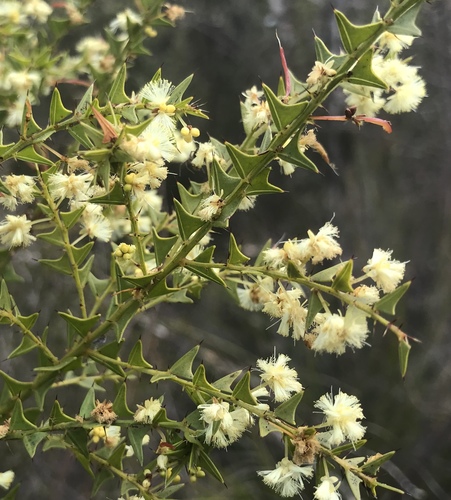
Acacia divergens Benth. is a diffuse, open, spreading shrub that typically grows 0.4 to 2.5 metres (1 foot 4 inches to 8 feet 2 inches) tall. Its outermost branches are long, undivided, and arch downwards. Branchlets have fine yellow ribs, and are either hairless or covered in short, soft hairs. The phyllodes are delta-shaped to triangular, with the narrower end at the base. They have a prominent gland-bearing angle along the upper edge, measure 6–10 mm (0.24–0.39 in) long and 3–8 mm (0.12–0.31 in) wide, end in a sharp point, and have a prominent midrib positioned close to the lower edge. Spiny, slender stipules 2–4 mm (0.079–0.157 in) long are often present at the base of the phyllodes.
Flowers are arranged as a single spherical head in leaf axils, held on a slender peduncle 3.5–10 mm (0.14–0.39 in) long. Each head holds five to ten cream-coloured to pale yellow flowers. Flowering occurs mostly from August to November. The seed pods are linear, curved, and often twisted, growing up to 70 mm (2.8 in) long and 2–3 mm (0.079–0.118 in) wide. The pods have a thin leathery to crusty texture and are hairless.
The seeds are roughly oblong in shape, 2.5–3.0 mm (0.098–0.118 in) long, glossy brown, and have an aril. A. divergens belongs to the A. biflora group, and its phyllodes closely resemble those of A. robiniae.
This wattle species most often grows near swamps and creeks. It also grows in jarrah forest, and near Augusta in coastal heath growing on sand over limestone. It has a discontinuous distribution, ranging from the Moora-Wongan Hills area south to the Augusta and Denmark areas, and east to the Stirling Range. It is found in the Avon Wheatbelt, Esperance Plains, Jarrah Forest, Swan Coastal Plain and Warren bioregions of south-western Western Australia.