About Acacia decurrens Willd.
Scientific name: Acacia decurrens Willd.
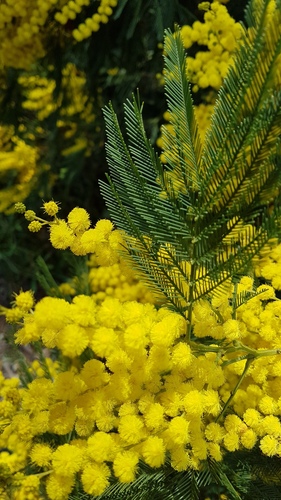
Description Acacia decurrens is a tall shrub or tree that typically grows up to 10 to 25 m (33 to 82 ft) in height, and has smooth or fissured greyish-black or black bark. Its more or less glabrous branchlets bear winged ridges 0.5–2 mm (0.020–0.079 in) wide. Young foliage tips are light green or yellowish. The dark green leaves are alternately arranged, bipinnate, borne on a 15–28 mm (0.59–1.10 in) long petiole and a 20–120 mm (0.79–4.72 in) long rhachis, with 3 to 13 pairs of pinnae. Each pinna has 15 to 45 pairs of linear, widely spaced pinnules that are 5–15 mm (0.20–0.59 in) long and 0.4–0.8 mm (0.016–0.031 in) wide. Glands are present at the base of every pair of pinnae.
Flowers are borne in spherical heads arranged in elongated racemes or in terminal groups on 3–7 mm (0.12–0.28 in) long peduncles. Each head is 4–7 mm (0.16–0.28 in) in diameter and holds 20 to 32 yellow, bright yellow or golden yellow flowers. The seed pods are straight to slightly curved, more or less flat with straight sides, 20–105 mm (0.79–4.13 in) long and 5–8.5 mm (0.20–0.33 in) wide. They are thinly leathery and mostly slightly constricted between the seeds, and mature from November to January.
Distribution and habitat Acacia decurrens is native to the coast and tablelands of New South Wales and the Australian Capital Territory, occurring mainly south of the Hunter Valley, and is common in the Sydney region. It grows in forest, woodland and heath, often along river banks, at altitudes up to 1,000 m (3,300 ft) in areas with annual rainfall of 700–1,400 mm (28–55 in). It most commonly grows in loamy soils derived from Wianamatta shale and sandstone, alongside trees such as grey gum (Eucalyptus punctata) and narrow-leaved ironbark (Eucalyptus crebra). It was extensively planted within New South Wales, so it is difficult to distinguish native vs naturalised populations in areas adjacent to its native range. This species has become naturalised in other Australian states: Queensland, Victoria, Western Australia and Tasmania, and has been introduced to other regions worldwide, including India, Africa, California, South America, New Zealand and China.
Ecology Acacia decurrens reproduces mainly via its dark brown or black seeds. Seeds can be dispersed by ants or birds, and form a persistent seedbank in soil. Seedlings typically grow rapidly after bushfire, and the species can colonise disturbed areas. Individual trees have a lifespan of 15 to 50 years. Sulphur-crested cockatoos feed on its unripe seeds. Its foliage is a food source for caterpillars of the butterflies double-spotted line blue (Nacaduba biocellata), moonlight jewel (Hypochrysops delicia), imperial hairstreak (Jalmenus evagoras), ictinus blue (Jalmenus ictinus), amethyst hairstreak (Jalmenus icilius), and silky hairstreak (Pseudalmenus chlorinda). Its wood is eaten by larvae of the jewel beetle species Agrilus australasiae, Cisseis cupripennis and Cisseis scabrosula.
Uses Uses of Acacia decurrens span chemical production, environmental management, and timber. Its flowers are edible and used in fritters. An edible gum that oozes from the tree trunk can be used as a lower-quality substitute for gum arabic, for example in fruit jelly production. The bark contains approximately 37–40% tannin. Yellow dye is produced from the flowers, and green dye is produced from the seed pods. The organic compound kaempferol is responsible for the flower color of A. decurrens. It has been grown for firewood, and as a fast-growing windbreak or shelter tree.
Use in horticulture Acacia decurrens adapts readily to cultivation and grows very quickly. It can be used as a shelter or specimen tree in large gardens and parks, and appears imposing when in flower. Cultivation is typically started by soaking seeds in warm water then sowing them outdoors; seeds retain their ability to germinate for many years. Fieldwork in the Southern Highlands of Australia found that the presence of bipinnate wattles (as understory or tree) correlates with reduced numbers of noisy miners, an aggressive bird species that displaces smaller birds from gardens and bushland. For this reason, use of these wattles (including A. decurrens) is recommended for green corridor establishment and revegetation projects.