About Acacia deanei (R.T.Baker) M.B.Welch, Coombs & McGlynn
Taxonomic Identity
Acacia deanei (R.T.Baker) M.B.Welch, Coombs & McGlynn is a shrub or tree that typically grows to a height of 1.5–7 m (4 ft 11 in – 23 ft 0 in).
Growth Form and Bark
It usually has many stems, with smooth bark that can be green, grey, brown, or brownish purple. Its branchlets are slightly flattened and covered with yellow, golden, or rust-coloured hairs.
Leaf Structure
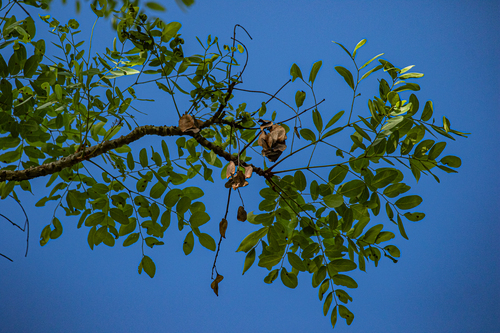
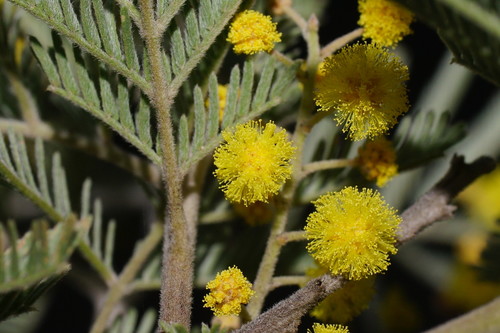
The leaves are leathery and bipinnate, borne on a petiole 4–30 mm (0.16–1.18 in) long, with 3 to 12 pairs of pinnae. Each pinna holds 11 to 32 pairs of widely spaced, linear to narrowly oblong pinnules that are 1–12 mm (0.039–0.472 in) long and 0.4–1.3 mm (0.016–0.051 in) wide.
Inflorescence Arrangement
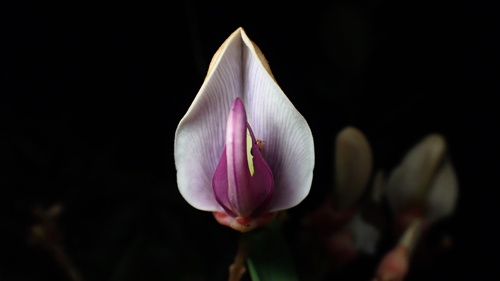
Flowers are arranged in spherical heads held in racemes, located in leaf axils or at the ends of branches, on peduncles 1–5 mm (0.039–0.197 in) long. Each flower head is 3.0–5.5 mm (0.12–0.22 in) in diameter and contains 15 to 30 cream-coloured to pale yellow or yellow flowers.
Flowering Period
Flowering time varies between the recognized subspecies of this species.
Seed Pod Characteristics
The seed pods are leathery, black or dark brown, linear to narrowly oblong, 35–180 mm (1.4–7.1 in) long, 5–12 mm (0.20–0.47 in) wide, and are more or less constricted between the seeds.
Similar Species
Acacia deanei is sometimes confused with Acacia mearnsii or Acacia parramattensis.
Overall Distribution
This species is widespread in inland southern Queensland, central New South Wales, and central Victoria in Australia. It grows in a variety of sclerophyll plant communities across a range of different soil types.
Subspecies deanei Distribution
Subspecies deanei occurs in the drier inland areas of southern Queensland, as far north as Gregory Springs Station near Porcupine, and is widespread across New South Wales as far south as Yanco and as far west as Louth. In Victoria, this subspecies is only known from the Chiltern area.
Subspecies paucijuga Distribution
Subspecies paucijuga occurs on the plains, slopes, and tablelands of New South Wales, as far north as Lightning Ridge and as far west as Rankins Springs. It is common in the Snowy River valley and extends south to Wedderburn.