About Acacia dealbata Link
Scientific name: Acacia dealbata Link
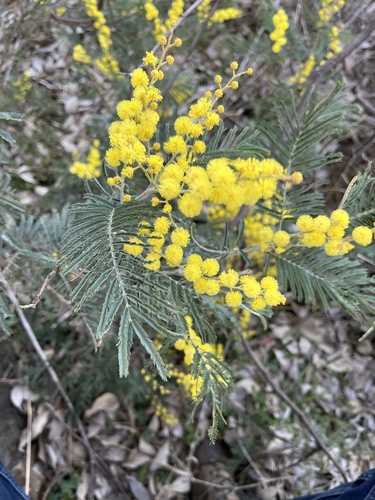
Description Acacia dealbata is an erect, bushy shrub or spreading tree that typically grows up to 30 m (98 ft) tall. It has smooth grey, brown or dark brown bark that becomes deeply corrugated with age. Its leaves are bipinnate, borne on a petiole up to 15 mm (0.59 in) long, with 6 to 30 pairs of pinnae. Each pinna holds 10 to 68 pairs of narrowly oblong to linear pinnules, measuring 0.7–5 mm (0.028–0.197 in) long and 0.4–0.8 mm (0.016–0.031 in) wide. The leaves are bluish grey or silvery and glaucous.
Flowers are arranged in spherical heads that form racemes or panicle-like groups, borne on a hairy peduncle 2–10 mm (0.079–0.394 in) long. Each head contains 13 to 42 yellow to bright yellow flowers. Flowering occurs from July to November. The seed pods are straight to slightly curved, more or less flat, and often slightly constricted between some or all seeds. They are slightly leathery, blue or purplish, and covered in a white powdery bloom.
Distribution and habitat Acacia dealbata is native to New South Wales, Victoria, Tasmania and the Australian Capital Territory, where it grows in forest or woodland across a variety of soils, most often on slopes and creek banks. The subspecies Acacia dealbata subsp. subalpina has a narrower native distribution, ranging from south of the Brindabella Range and Braidwood in New South Wales to the Bonang and Gelantipy areas in north-eastern Victoria. The species has been widely introduced to Mediterranean, warm temperate, and highland tropical landscapes globally.
Use in horticulture Acacia dealbata is widely cultivated as an ornamental plant in warm temperate regions of the world, and has become naturalised in many areas including: Sochi (Black Sea coast of Russia), southwestern Western Australia, southeastern South Australia, Norfolk Island, the Mediterranean region from Portugal to Greece and Morocco to Israel, Yalta (Crimea, Ukraine), California, Madagascar, southern Africa (South Africa, Zimbabwe), the highlands of southern India, south-western China and Chile. It is hardy down to −5 °C (23 °F), but cannot survive prolonged frost. It prefers a sheltered position in full sun, and grows best in acid or neutral soil. It has been awarded the Royal Horticultural Society's Award of Garden Merit.
Other uses Flowers and new tip shoots are harvested for use as cut flowers; in the florist trade, this material is known as "mimosa" (not to be confused with plants in the genus Mimosa). In Italy, Albania, Russia and Georgia, the flowers are frequently gifted to women on International Women's Day. Flower essence from this species, called 'mimosa' (or 'cassie' in older texts), is used in perfumes. The leaves are sometimes added to Indian chutney.
Indigenous Australian use: The Ngunnawal people of the Australian Capital Territory and Wiradjuri people of New South Wales traditionally used the bark to make coarse rope and string, resinous sap for glue or mixed with ash to make poultices, timber for tools, and seeds to make flour.
The timber is suitable for furniture and indoor work, but has limited mainstream use, mainly used for craft furniture and wood turning. It is honey-colored, often with distinctive grain patterns such as birdseye and tiger stripes. It has a medium density of 540–720 kg/m³, and is similar to the timber of its close relative blackwood, but is lighter in tone and lacks blackwood's dark heartwood.