About Acacia complanata A.Cunn. ex Benth.
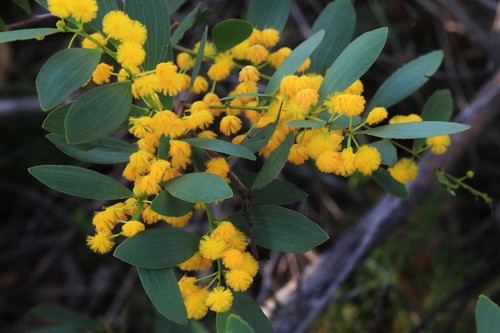
Acacia complanata A.Cunn. ex Benth., commonly known as flat-stemmed wattle, is a shrub or tree that typically grows up to 5–6 m (16–20 ft) tall, and has downwards arching branches. Its branchlets are more or less winding, flattened, narrowly winged, and glabrous. The phyllodes are narrowly elliptic, mostly 50–100 mm (2.0–3.9 in) long and 10–30 mm (0.39–1.18 in) wide, thinly leathery and glabrous, with 7 to 9 prominent veins. Flowers are arranged in groups of 4 to 8 spherical heads, which grow in leaf axils on peduncles 8–12 mm (0.31–0.47 in) long. Each flower head is around 6 mm (0.24 in) in diameter and holds mostly 35 to 45 bright yellow flowers. Flowering generally occurs from November to March. After flowering, it produces linear, glabrous seed pods that are thinly leathery to crusty, up to 150 mm (5.9 in) long and 6–10 mm (0.24–0.39 in) wide, with a rounded shape over the seeds. The seeds are more or less spherical, dull, dark brown, and 4–5 mm (0.16–0.20 in) long. This species is widely distributed across south-eastern Queensland, from Jericho in the west to Bundaberg in the east. It is also found in New South Wales, ranging southwest to the Dumaresq River and south along the north coast to around Coffs Harbour, with an additional disjunct population near Torrington. It grows on low ridges in gravelly, sandy, or loamy soils, often over sandstone, and usually occurs in heathland or dry sclerophyll forest. In horticulture, this wattle species is considered ideal for suburban gardens, and produces flowers multiple times per year. It can be pruned to a desired shape, and recovers from fire via a lignotuber. It is easily propagated from seed, after pretreatment by either soaking in boiling water or scarification.