About Acacia colletioides Benth.
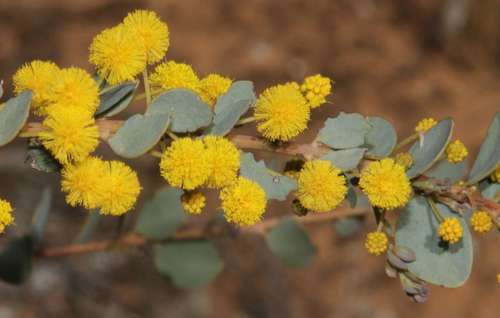
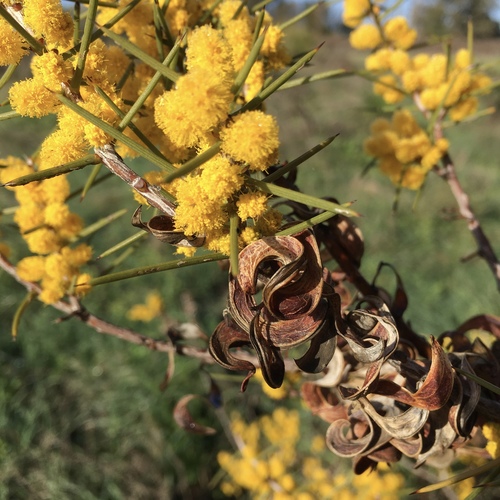
Acacia colletioides (common name Wait-a-while) is a species of shrub or tree that typically reaches 0.5 to 3 meters (1 foot 8 inches to 9 feet 10 inches) in height. Its branchlets are mostly hairless, and bear scars left by fallen phyllodes. The phyllodes are stalkless, attached to distinct yellow projections on the stem. They are straight to slightly curved, roughly cylindrical in shape, and usually measure 15 to 30 millimeters (0.59 to 1.18 inches) long and 1.0 to 1.5 millimeters (0.039 to 0.059 inches) wide, tapering to a sharp point. Flowers are arranged in two roughly spherical or broadly elliptic heads that grow from leaf axils on stalks called peduncles 1.5 to 5 millimeters (0.059 to 0.197 inches) long. Each head measures 3 to 5 millimeters (0.12 to 0.20 inches) long and 3 to 4.5 millimeters (0.12 to 0.18 inches) in diameter, and holds 12 to 24 bright yellow flowers. Flowering occurs between July and November. After flowering, the species produces linear seed pods that are constricted between individual seeds. The pods are hairless, thinly leathery, and grow up to 70 millimeters (2.8 inches) long and 3 to 5 millimeters (0.12 to 0.20 inches) wide. The seeds are oval to egg-shaped, black and shiny, measuring 3.5 to 4.0 millimeters (0.14 to 0.16 inches) long, with an orange or yellow aril that almost completely surrounds the seed. Wait-a-while occurs in dry regions, ranging from near Geraldton on Western Australia’s west coast, through parts of South Australia and north-western Victoria, to the western slopes and plains south and west of the Byrock-Nyngan area in New South Wales. It typically grows in mallee shrubland or open woodland. In Western Australia, it is found in the Avon Wheatbelt, Coolgardie, Gascoyne, Geraldton Sandplains, Gibson Desert, Great Victoria Desert, Murchison, Nullarbor and Yalgoo bioregions, and grows in a wide range of soil types. In Victoria, it occurs in the Murray mallee, Lowan mallee, Murray scroll belt and Robinvale Plains bioregions in the state’s north-west. It is most often found as a component of mallee scrub or open woodland communities growing in sandy loam soils.