About Acacia brownii (Poir.) Steud.
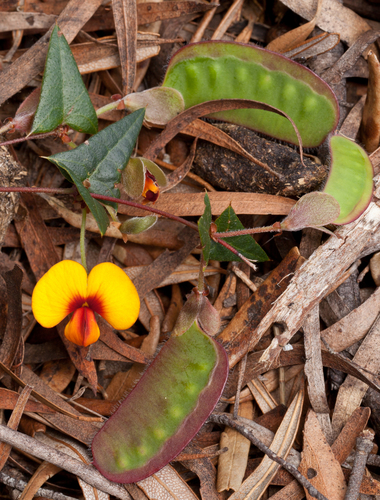
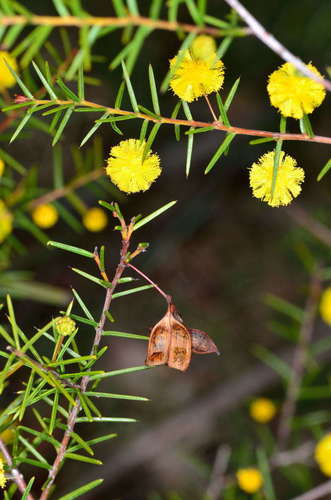
Acacia brownii, commonly called heath wattle, is an erect or spreading shrub that typically reaches a height of 0.3 to 1 m (1 ft 0 in to 3 ft 3 in). It has branchlets that range from glabrous to sparsely hairy. Its phyllodes are more or less rigid, straight, and round or four-angled in cross-section, ending in a sharp point. The phyllodes measure 8–20 mm (0.31–0.79 in) long and up to approximately 1 mm (0.039 in) wide, with a distinct prominent midrib and awl-shaped stipules at their base. Flowers are arranged in spherical heads that grow in leaf axils, borne on a peduncle 4–15 mm (0.16–0.59 in) long. Each flower head is 5–10 mm (0.20–0.39 in) in diameter and holds 12 to 30 bright yellow flowers. Flowering occurs between July and November. The seed pods are more or less curved, flat, and leathery, measuring 15–80 mm (0.59–3.15 in) long and 3–5 mm (0.12–0.20 in) wide. This wattle species resembles Acacia ulicifolia. A. ulicifolia is a sprawling, semi-prostrate shrub less than 1 m (3 ft 3 in) high, with linear phyllodes 8–25 mm (0.31–0.98 in) long that have a pronounced midrib, stipules that often fall off as phyllodes mature, and flowers ranging from bright golden to deep golden. Heath wattle grows in sandy or clay loam in dry sclerophyll forest, woodland, or heath. It is distributed across southern and eastern Victoria, New South Wales, and Queensland in Australia. It occurs along the Great Dividing Range, from the Grampians region of Victoria in the south, through New South Wales, north to around Burra Burri in Queensland.