About Acacia brachybotrya Benth.
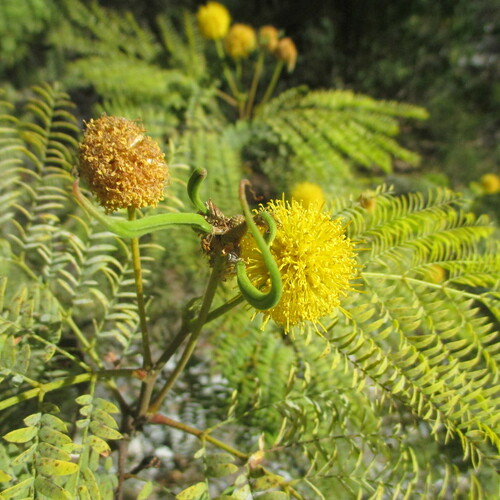
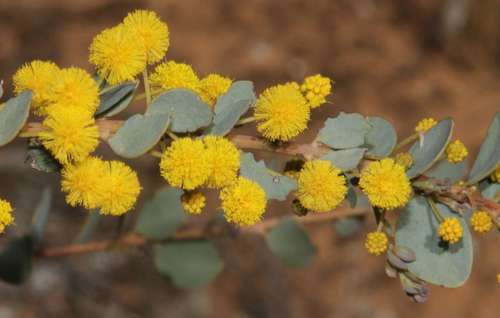
Acacia brachybotrya Benth. is a dense, rounded, erect or spreading shrub that usually reaches a height of 1 to 3 meters (3 feet 3 inches to 9 feet 10 inches), and is often wider than it is tall. Its phyllodes vary in shape, most commonly from lance-shaped to egg-shaped with the narrower end toward the base. They range in color from greyish-green to glaucous, and are 10 to 35 millimeters (0.39 to 1.38 inches) long and 5 to 12 millimeters (0.20 to 0.47 inches) wide. Flowers are arranged on racemes 0.5 to 2 millimeters (0.020 to 0.079 inches) long, which bear up to four spherical flower heads on 5 to 12 millimeter (0.20 to 0.47 inch) long peduncles. Each flower head holds 28 to 36 golden-yellow flowers. Flowering occurs from July to November. After flowering, this species produces linear pods that resemble a string of beads, with a texture from firmly papery to leathery. The pods can grow up to 90 millimeters (3.5 inches) long and 5 to 11 millimeters (0.20 to 0.43 inches) wide. Seeds are 4.0 to 5.5 millimeters (0.16 to 0.22 inches) long, brown to black in color, and have an aril at one end. Commonly known as grey mulga, this species is widely distributed across semi-arid areas of south-eastern Australia. Its range extends from around Yalata in western South Australia east to around Bendigo in Victoria, and north as far as Nymagee in New South Wales. It grows in many different soil types, and is most often found as a member of mallee plant communities.