About Acacia binervata DC.
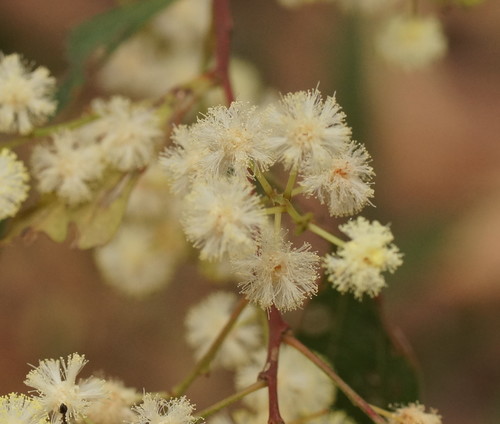
Acacia binervata, commonly called two-veined hickory, grows as a bushy shrub typically reaching 5 m (16 ft) in height, or a small tree growing up to 15 m (49 ft). It has grey-black or grey-brown bark and hairless, glabrous branchlets. Its glabrous phyllodes are narrowly egg-shaped to narrowly elliptic, 60–160 mm (2.4–6.3 in) long and 10–30 mm (0.39–1.18 in) wide. Each phyllode has two prominent veins and a gland located 10–25 mm (0.39–0.98 in) above its base. Flowers are arranged in racemes 30–60 mm (1.2–2.4 in) long, holding between seven and twelve spherical flower heads. Each flower head sits on a pedicel 6–12 mm (0.24–0.47 in) long and contains 15 to 25 pale yellow to nearly white flowers. Flowering occurs between August and November. After flowering, it produces seed pods that are thinly crust-like to leathery, 35–140 mm (1.4–5.5 in) long and 9–12 mm (0.35–0.47 in) wide. The pods contain oblong to elliptic seeds about 5 mm (0.2 in) long, each with a black, thread-like stalk and a club-shaped aril. This species is distributed along the east coast of Australia, ranging from south-east Queensland through most of New South Wales. Its range extends from around Narooma in southern New South Wales west to around Mittagong, and north to the Mount Tambourine area in southern Queensland. It grows on moist sites in sandy or basaltic soils, as a component of tall sclerophyll forest or on the margins of rainforest communities. For horticultural use, Acacia binervata can be grown from seed, but the seed requires scarification before planting. It is a hardy, fast growing plant that tolerates damp areas well, and prefers positions in full sun or part shade. It can be grown as a dense shade tree, shelter tree or hedge, and is frost hardy. The fungal pathogen Sarcostroma acaciae, which causes leaf spots, occurs on multiple Acacia species including Acacia binervata in Australia.