About Acacia baileyana F.Muell.
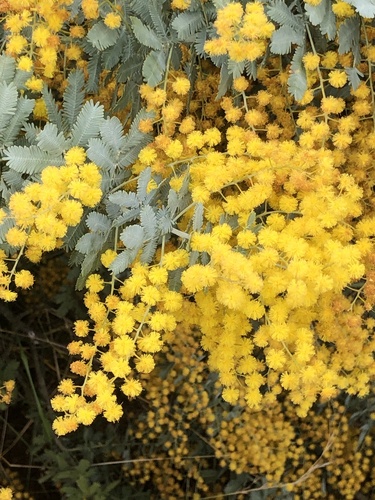
Scientific name: Acacia baileyana F.Muell. Description: Acacia baileyana (commonly known as Cootamundra wattle) is a shrub or tree that typically grows 3–10 m (9.8–32.8 ft) tall, and has smooth, grey or brown bark. Its leaves are more or less sessile, somewhat leathery, and glaucous, with mostly two to four pairs of pinnae that are oblong to narrowly oblong, 5–8 mm (0.20–0.31 in) long and 0.7–1.0 mm (0.028–0.039 in) wide. Flowers are arranged in spherical heads that form racemes in leaf axils; the racemes are 30–100 mm (1.2–3.9 in) long, much longer than the leaves. The heads grow on peduncles 3–7 mm (0.12–0.28 in) long; each head is 3.5–7 mm (0.14–0.28 in) in diameter and holds 11 to 25 bright yellow to golden flowers. Flowering occurs from June to September. The seed pods are leathery, straight, more or less flat, with straight sides, and measure 30–100 mm (1.2–3.9 in) long and 7.5–15 mm (0.30–0.59 in) wide. Distribution and habitat: Cootamundra wattle is endemic to the Temora-Cootamundra district of Australia, where it grows in open forest, woodland and mallee, in stony soils on creek flats and hilly country. It is often naturalised on roadsides, along railways in disturbed bushland, and in urban areas across all mainland Australian states, and is classified as an environmental weed in some locations. Uses: Acacia baileyana is used in Europe’s cut flower industry. It is also used as food for bees to support honey production. American urban landscape designer Renée Gunter uses this plant in her South Los Angeles lawn as a drought-resistant alternative to more water-thirsty plants. Use in horticulture: This plant is adaptable and easy to grow. It has been awarded the Royal Horticultural Society's Award of Garden Merit. It readily naturalises (escapes cultivation) into surrounding bushland, and hybridises with some other wattle species, most notably the rare and endangered Sydney Basin species Acacia pubescens. A prostrate weeping form of the species is in cultivation; its origin is unknown, but it is a popular garden plant, with cascading horizontal branches that suit growing in rockeries. The fine foliage of the original Cootamundra wattle is grey-green, but a blue-purple foliaged cultivar known as 'Purpurea' is very popular.