About Acacia auriculiformis A.Cunn. ex Benth.
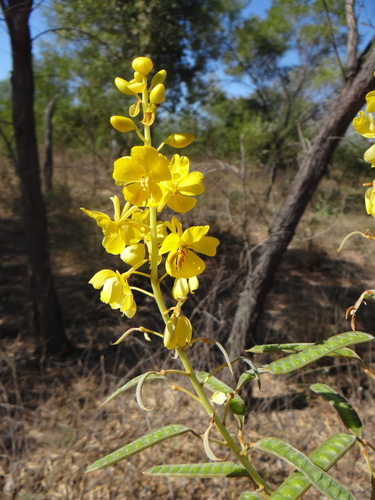
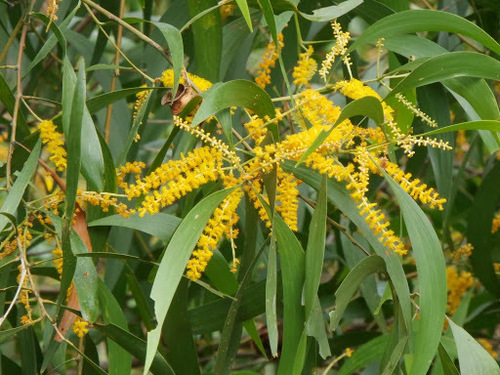
Scientific name: Acacia auriculiformis A.Cunn. ex Benth. Description: Acacia auriculiformis, also commonly called ear-pod wattle, is a mostly glabrous tree. It typically grows 8–10 m (26–33 ft) tall, and rarely reaches up to 35 m (115 ft). It has thin branchlets, with smooth bark; older individuals develop fissured bark. Its phyllodes are very narrowly elliptic, and sometimes curved. Most phyllodes are 100–200 mm (3.9–7.9 in) long and 12–40 mm (0.47–1.57 in) wide, marked with many longitudinal veins, 3 to 5 of which are more prominent than the others. The flowers are bright yellow to golden-yellow, arranged in 1 to several spikes in leaf axils. Each spike is 50–85 mm (2.0–3.3 in) long, borne on a 4–8 mm (0.16–0.31 in) long peduncle. Flowering occurs between February and August. The fruit is a strongly curved or spirally coiled, sometimes twisted, thickly leathery to woody pod, measuring around 50–80 mm (2.0–3.1 in) long and 10–18 mm (0.39–0.71 in) wide. The pod contains flattened, dark brown to black seeds that are 4–6 mm (0.16–0.24 in) long and 3–4 mm (0.12–0.16 in) wide, with an orange, yellow or red aril. Distribution and habitat: This species grows in sandy or loamy soils near watercourses and swamps in open forest. Its native range includes Cape York Peninsula in Queensland, northern Northern Territory, the Central and Western Provinces of New Guinea, and the Kei Islands of Indonesia. It is also recorded as naturalised in Western Australia. Uses: Extracts of Acacia auriculiformis heartwood inhibit wood-attacking fungi. Aqueous extracts of this species inhibit the development of Bactrocera cucurbitae, the melon fly.