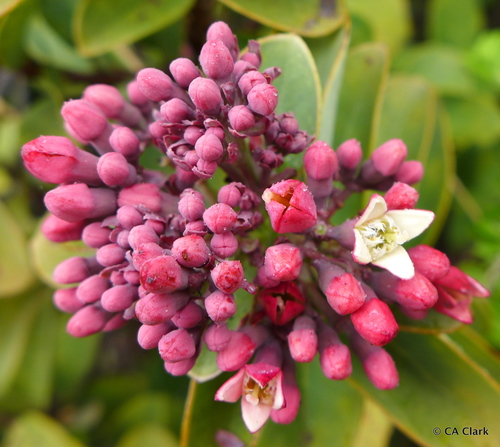
How to Identify Santalaceae

Santalaceae is a plant family in the Plantae kingdom, order Santalales, class Magnoliopsida. The family contains 24 accepted species worldwide. Some species in this family are toxic — exercise caution when handling unknown specimens.

Key Identification Features

For instant identification in the field, use the iNature app — AI-powered, works offline.
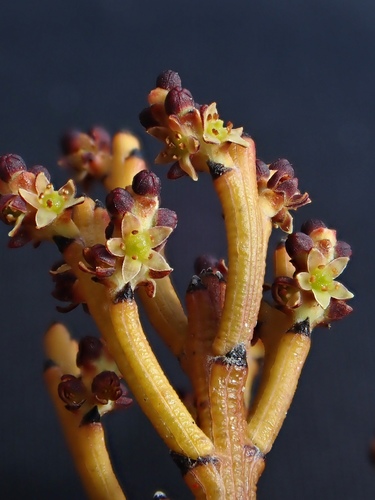
Representative Santalaceae Species

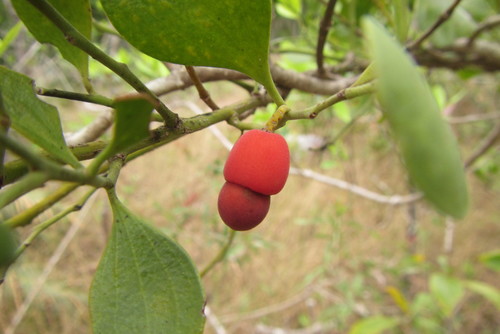
How to identify Exocarpos bidwillii Hook.fil.

Exocarpos bidwillii Hook.fil.

Exocarpos bidwillii Hook.fil.

Exocarpos bidwillii is a leafless sprawling endemic New Zealand shrub in Santala…

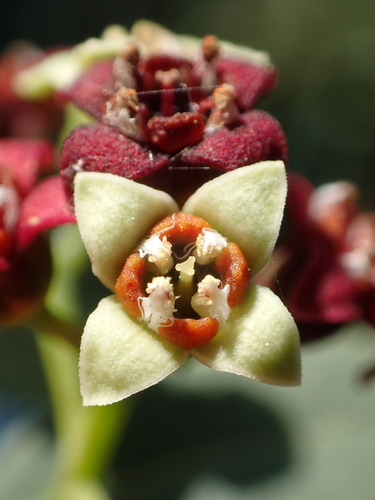
How to identify Exocarpos cupressiformis Labill.

Exocarpos cupressiformis Labill.

Exocarpos cupressiformis Labill.

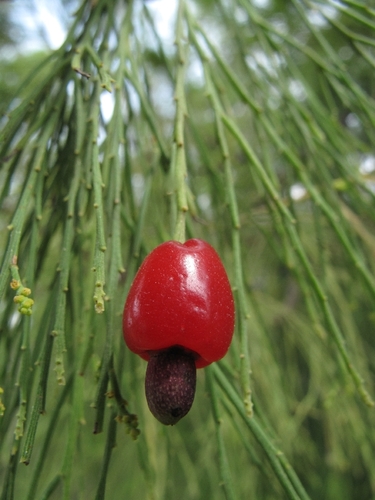
Exocarpos cupressiformis, cherry ballart, is a hemiparasitic Australian tree wit…

⚠️ Poisonous
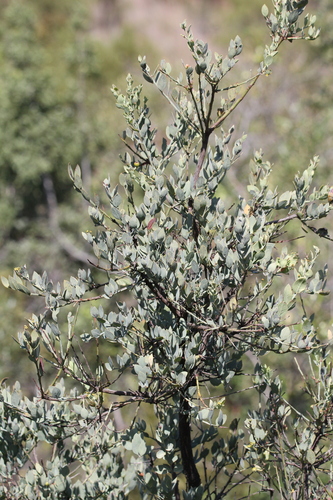
How to identify Exocarpos syrticola (F.Muell. ex Miq.) Stauffer

Exocarpos syrticola (F.Muell. ex Miq.) Stauffer

Exocarpos syrticola (F.Muell. ex Miq.) Stauffer

Exocarpos syrticola, commonly called coastal ballart, is an endemic Australian S…

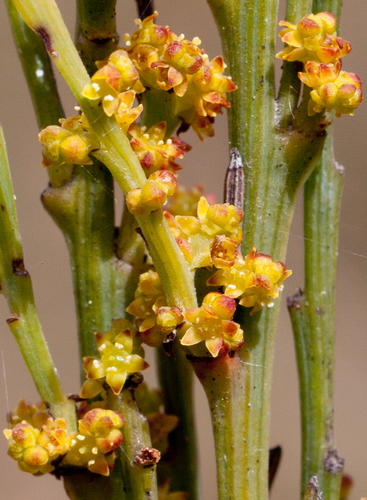
How to identify Osyris alba L.

Osyris alba L.

Osyris alba L.

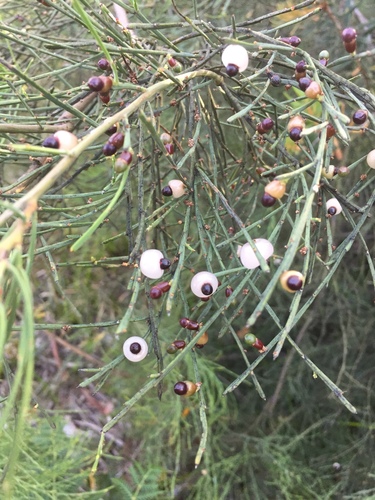
Osyris alba L. is a hemiparasitic broom-like shrub, widespread across the Medite…

How to identify Santalum freycinetianum var. pyrularium (A.Gray) Stemmerm.

Santalum freycinetianum var. pyrularium (A.Gray) Stemmerm.

Santalum freycinetianum var. pyrularium (A.Gray) Stemmerm.

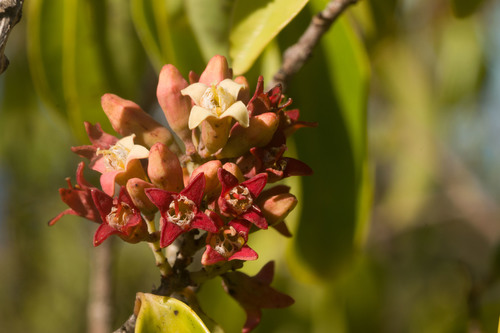
Santalum freycinetianum var. pyrularium is an endemic Hawaiian root hemiparasiti…

How to identify Osyris compressa (P.J.Bergius) A.DC.

Osyris compressa (P.J.Bergius) A.DC.

Osyris compressa (P.J.Bergius) A.DC.

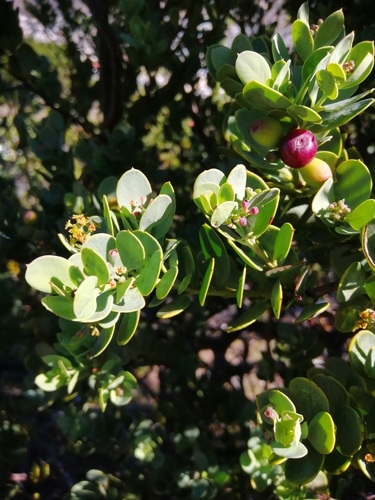
Osyris compressa (Cape sumach) is a hemiparasitic South African shrub or small t…

How to identify Exocarpos latifolius R.Br.

Exocarpos latifolius R.Br.

Exocarpos latifolius R.Br.

Exocarpos latifolius is a hemiparasitic Santalaceae tree with edible stalks, use…

How to identify Santalum album L.

Santalum album L.

Santalum album L.

Santalum album L. (white sandalwood) is a parasitic evergreen tree, the primary …

How to identify Osyris lanceolata Steud. & Hochst. ex A.DC.

Osyris lanceolata Steud. & Hochst. ex A.DC.

Osyris lanceolata Steud. & Hochst. ex A.DC.

Osyris lanceolata (African sandalwood) is a semi-parasitic plant harvested for i…

How to identify Exocarpos strictus R.Br.

Exocarpos strictus R.Br.

Exocarpos strictus R.Br.

Exocarpos strictus is a versatile Australian native shrub with cherry-like fruit…

How to identify Santalum freycinetianum Gaudich.

Santalum freycinetianum Gaudich.

Santalum freycinetianum Gaudich.

Santalum freycinetianum (ʻIliahi) is an endemic Hawaiian flowering tree harveste…

How to identify Santalum haleakalae Hillebr.

Santalum haleakalae Hillebr.

Santalum haleakalae Hillebr.

Santalum haleakalae is a hemiparasitic Hawaiian sandalwood with two varieties, d…

Browse all 24 Santalaceae species →

Frequently Asked Questions

How do you identify Santalaceae?

Santalaceae plants belong to the Santalales order in the Plantae kingdom. The wood of this tree is very fine-grained with little distinct grain pattern, but often has striking colour variation, and was historically used for cabinet work. For instant identification, use the iNature app — AI-powered and works offline.

What are the key characteristics of Santalaceae?

Santalaceae is classified in the order Santalales, class Magnoliopsida, phylum Tracheophyta. Hawaii became so well known for its sandalwood in China that people in the Macau area called Hawaii "Tan Heung Shan", which translates to "the Sandalwood Mountains".

⚠️ Are any Santalaceae species poisonous?

Yes, some Santalaceae species are toxic or poisonous. Always exercise caution with unknown specimens. View poisonous Santalaceae species or browse the full poisonous species guide.

Sources: GBIF, iNaturalist, Wikipedia · Disclaimer

Start Exploring Nature Today

Download iNature for free. 10 identifications on us. No account needed. No credit card required.

Download Free on App Store