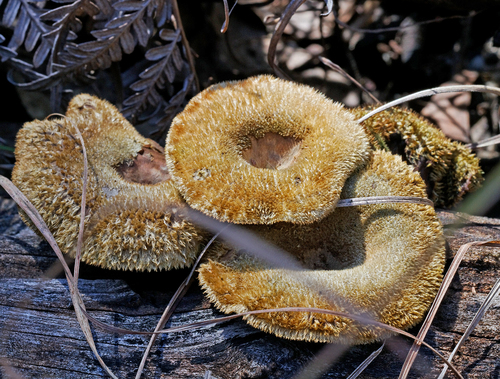
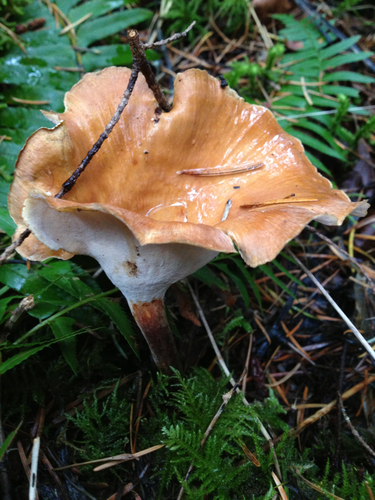
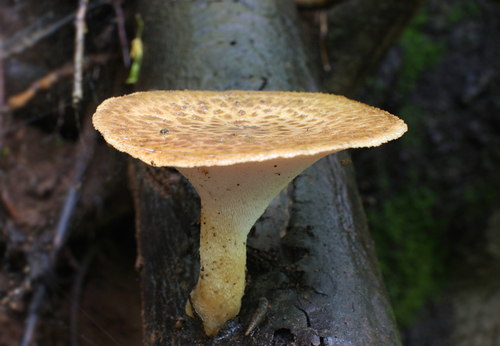
How to Identify Polyporaceae

Polyporaceae is a fungus family in the Fungi kingdom, order Polyporales, class Agaricomycetes. The family contains 94 accepted species worldwide.

Key Identification Features

For instant identification in the field, use the iNature app — AI-powered, works offline.
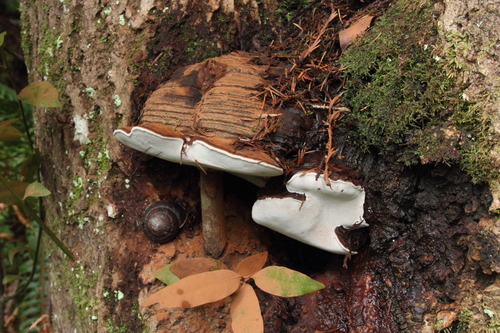
Representative Polyporaceae Species

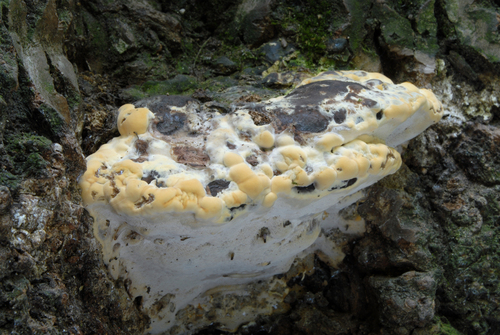
How to identify Ganoderma brownii (Murrill) Gilb.

Ganoderma brownii (Murrill) Gilb.

Ganoderma brownii (Murrill) Gilb.

Ganoderma brownii is a perennial polypore that parasitizes hardwoods and conifer…

How to identify Vanderbylia fraxinea (Bull.) D.A.Reid

Vanderbylia fraxinea (Bull.) D.A.Reid

Vanderbylia fraxinea (Bull.) D.A.Reid

Vanderbylia fraxinea is a poroid pathogenic fungus in Polyporaceae that infects …

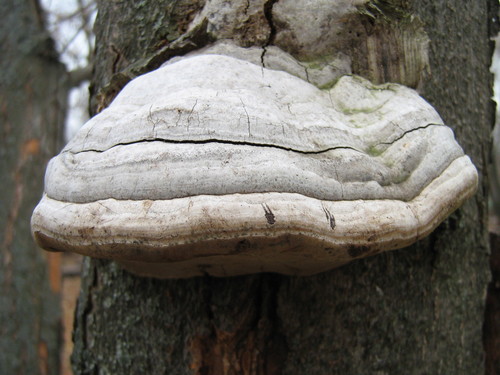
How to identify Fomes fomentarius (L.) Fr.

Fomes fomentarius (L.) Fr.

Fomes fomentarius (L.) Fr.

Fomes fomentarius is a common circumboreal wood-decay bracket fungus that grows …

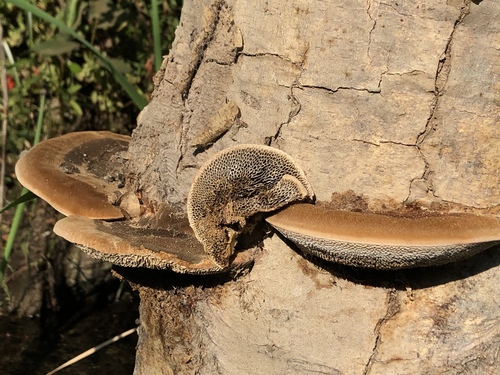
How to identify Coriolopsis gallica (Fr.) Ryvarden

Coriolopsis gallica (Fr.) Ryvarden

Coriolopsis gallica (Fr.) Ryvarden

Coriolopsis gallica is a non-pathogenic white-rot fungus that preferentially deg…

How to identify Microporus affinis (Blume & T.Nees) Kuntze

Microporus affinis (Blume & T.Nees) Kuntze

Microporus affinis (Blume & T.Nees) Kuntze

Microporus affinis is a widespread common polypore fungus in Polyporaceae found …

How to identify Cerioporus varius (Pers.) Zmitr. & Kovalenko

Cerioporus varius (Pers.) Zmitr. & Kovalenko

Cerioporus varius (Pers.) Zmitr. & Kovalenko

Cerioporus is a distinct Polyporaceae genus with former Polyporus species and re…

How to identify Picipes badius (Pers.) Zmitr. & Kovalenko

Picipes badius (Pers.) Zmitr. & Kovalenko

Picipes badius (Pers.) Zmitr. & Kovalenko

Picipes badius is a tough inedible polypore fungus that causes white rot on hard…

How to identify Lentinus levis (Berk. & M.A.Curtis) Murrill

Lentinus levis (Berk. & M.A.Curtis) Murrill

Lentinus levis (Berk. & M.A.Curtis) Murrill

Lentinus levis is an edible saprotrophic agaric that grows on dead hardwood in w…

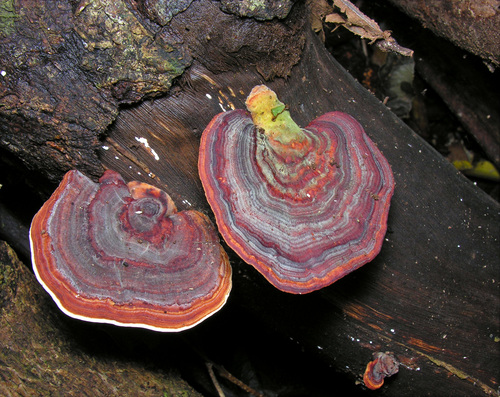
How to identify Trametes cinnabarina (Jacq.) Fr.

Trametes cinnabarina (Jacq.) Fr.

Trametes cinnabarina (Jacq.) Fr.

Pycnoporus sanguineus (formerly Trametes cinnabarina) is a fungus with a range o…

How to identify Lentinus fasciatus Berk.

Lentinus fasciatus Berk.

Lentinus fasciatus Berk.

Lentinus fasciatus Berk. is a saprotrophic wood-decaying fungus found across par…

How to identify Picipes melanopus (Pers.) Zmitr. & Kovalenko

Picipes melanopus (Pers.) Zmitr. & Kovalenko

Picipes melanopus (Pers.) Zmitr. & Kovalenko

Picipes melanopus is an inedible polypore fungus with a brown velvety depressed …

How to identify Polyporus tuberaster (Jacq. ex Pers.) Fr.

Polyporus tuberaster (Jacq. ex Pers.) Fr.

Polyporus tuberaster (Jacq. ex Pers.) Fr.

Polyporus tuberaster, the tuberous polypore, is an edible Polyporus fungus that …

Browse all 94 Polyporaceae species →

Frequently Asked Questions

How do you identify Polyporaceae?

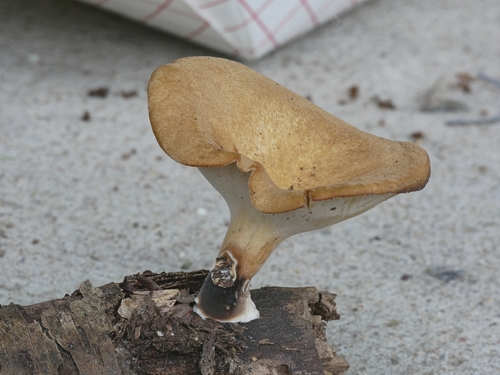
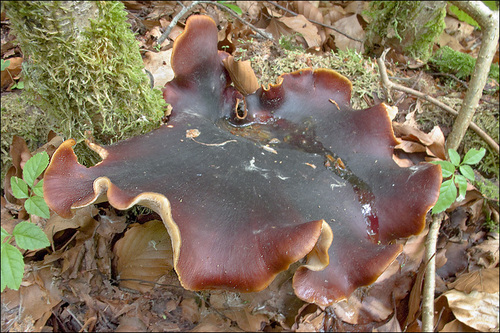
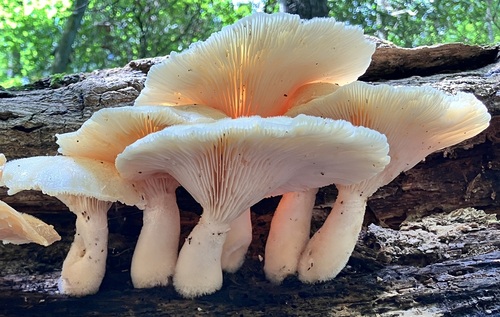
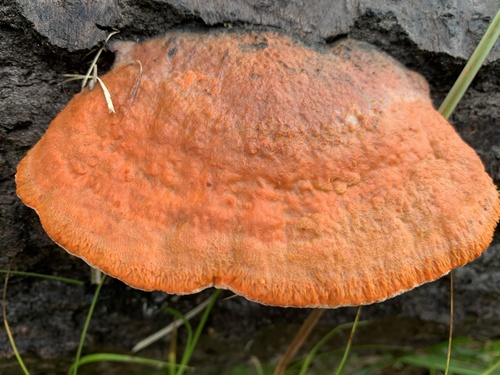
Polyporaceae funguss belong to the Polyporales order in the Fungi kingdom. This species typically has broad concentric ridges and a blunt, rounded margin. For instant identification, use the iNature app — AI-powered and works offline.

What are the key characteristics of Polyporaceae?

Polyporaceae is classified in the order Polyporales, class Agaricomycetes, phylum Basidiomycota. Many species that are now classified in Cerioporus were previously placed in the genus Polyporus, but phylogenetic analysis has confirmed that Cerioporus is a distinct, separate genus.

Sources: GBIF, iNaturalist, Wikipedia · Disclaimer

Start Exploring Nature Today

Download iNature for free. 10 identifications on us. No account needed. No credit card required.

Download Free on App Store