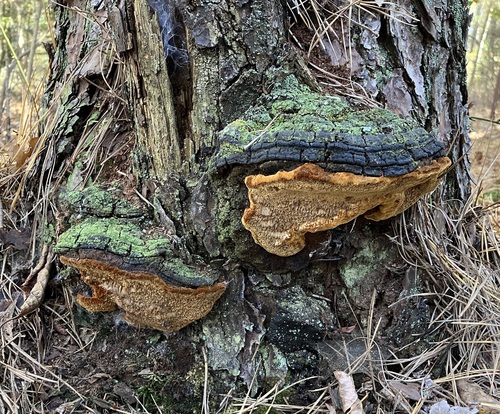
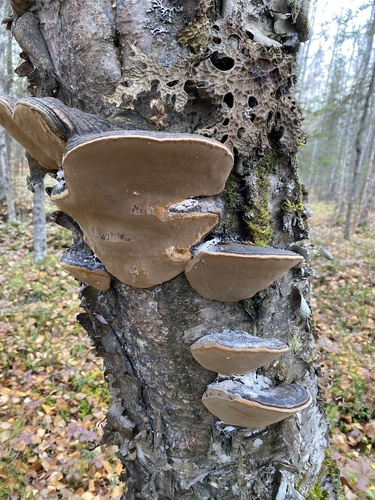
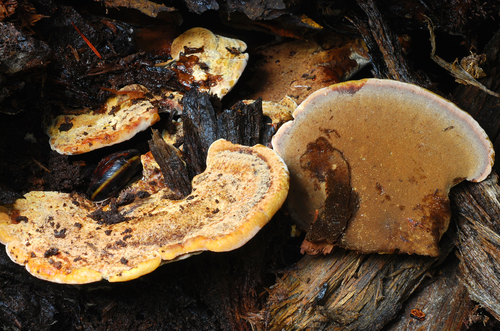
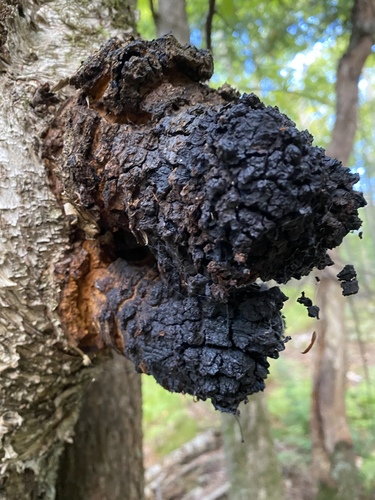
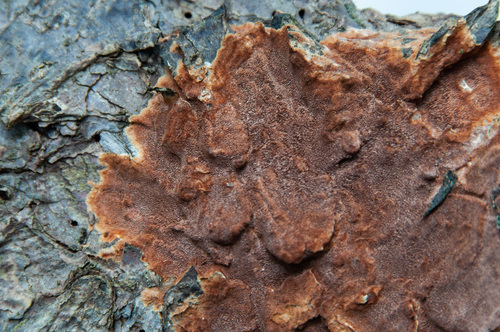
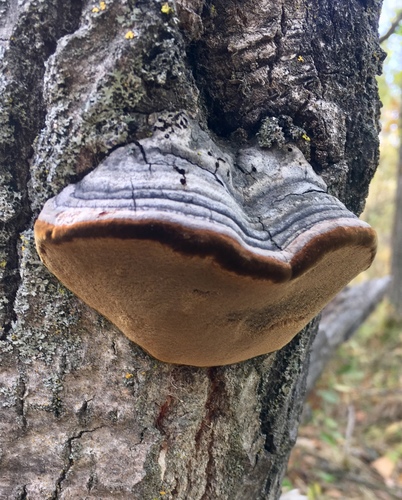
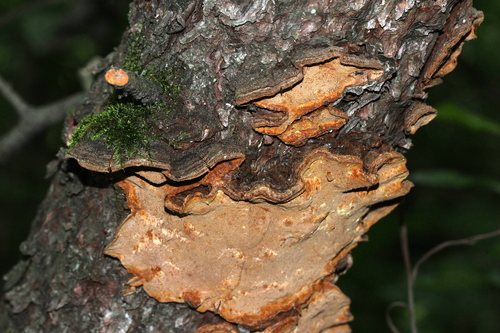
How to Identify Hymenochaetaceae

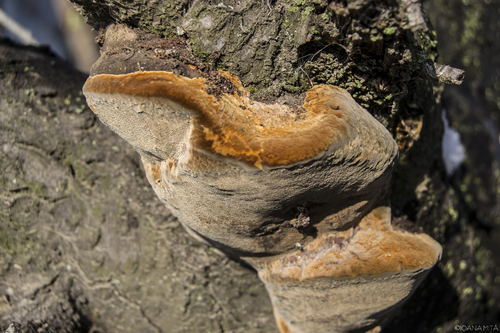
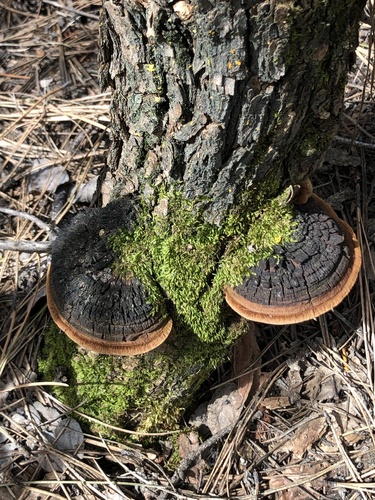
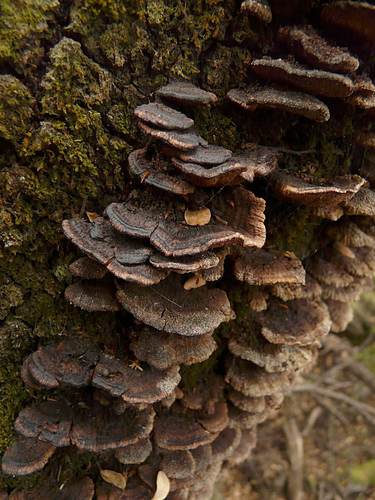
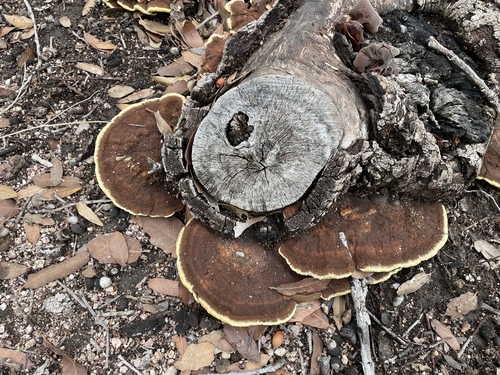
Hymenochaetaceae is a fungus family in the Fungi kingdom, order Hymenochaetales, class Agaricomycetes. The family contains 48 accepted species worldwide.

Key Identification Features

For instant identification in the field, use the iNature app — AI-powered, works offline.
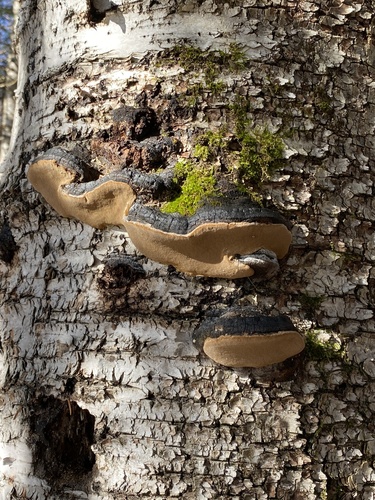
Representative Hymenochaetaceae Species

How to identify Phellinus lundellii Niemelä

Phellinus lundellii Niemelä

Phellinus lundellii Niemelä

Phellinus lundellii is a Hymenochaetaceae fungus species found in Eurasia and No…

How to identify Porodaedalea pini (Brot.) Murrill

Porodaedalea pini (Brot.) Murrill

Porodaedalea pini (Brot.) Murrill

Porodaedalea pini is a non-edible pathogenic fungus that causes red ring rot in …

How to identify Phellinus igniarius (L.) Quél.

Phellinus igniarius (L.) Quél.

Phellinus igniarius (L.) Quél.

Phellinus igniarius is a wood-rotting polypore fungus that is inedible but has p…

How to identify Inonotus cuticularis (Bull.) P.Karst.

Inonotus cuticularis (Bull.) P.Karst.

Inonotus cuticularis (Bull.) P.Karst.

Inonotus cuticularis, the clustered bracket, is a plant pathogenic fungus in Hym…

How to identify Inonotus obliquus (Fr.) Pilát

Inonotus obliquus (Fr.) Pilát

Inonotus obliquus (Fr.) Pilát

Inonotus obliquus, or chaga, is a boreal pathogenic fungus commonly marketed as …

How to identify Phellinus pomaceus (Pers.) Maire

Phellinus pomaceus (Pers.) Maire

Phellinus pomaceus (Pers.) Maire

Phellinus pomaceus is a long-lived, weakly pathogenic plant fungus commonly foun…

How to identify Phellinus robiniae (Murrill) A.Ames

Phellinus robiniae (Murrill) A.Ames

Phellinus robiniae (Murrill) A.Ames

Fulvifomes robiniae, the cracked cap polypore, is a Hymenochaetaceae fungus that…

How to identify Nothonotus nothofagi (G.Cunn.) Y.C.Dai, F.Wu, L.W.Zhou, Vlasák & B.K.Cui

Nothonotus nothofagi (G.Cunn.) Y.C.Dai, F.Wu, L.W.Zhou, Vlasák & B.K.Cui

Nothonotus nothofagi (G.Cunn.) Y.C.Dai, F.Wu, L.W.Zhou, Vlasák & B.K.Cui

Nothonotus nothofagi is a parasitic Hymenochaetaceae fungus that causes white ro…

How to identify Phellinus gilvus (Schwein.) Pat.

Phellinus gilvus (Schwein.) Pat.

Phellinus gilvus (Schwein.) Pat.

Phellinus gilvus is a pathogenic fungus used in traditional Chinese medicine wit…

How to identify Phellinidium ferrugineofuscum (P.Karst.) Fiasson & Niemelä

Phellinidium ferrugineofuscum (P.Karst.) Fiasson & Niemelä

Phellinidium ferrugineofuscum (P.Karst.) Fiasson & Niemelä

Phellinidium ferrugineofuscum is a Hymenochaetaceae fungus native to Eurasia and…

How to identify Phellinus tremulae (Bondartsev) Bondartsev & P.N.Borisov

Phellinus tremulae (Bondartsev) Bondartsev & P.N.Borisov

Phellinus tremulae (Bondartsev) Bondartsev & P.N.Borisov

Phellinus tremulae, the aspen bracket, is a Hymenochaetaceae polypore that cause…

How to identify Phellinus chrysoloma (Fr.) Donk

Phellinus chrysoloma (Fr.) Donk

Phellinus chrysoloma (Fr.) Donk

Phellinus chrysoloma is a near-threatened boreal forest fungus that parasitizes …

Browse all 48 Hymenochaetaceae species →

Frequently Asked Questions

How do you identify Hymenochaetaceae?

Hymenochaetaceae funguss belong to the Hymenochaetales order in the Fungi kingdom. In early decay, affected wood takes on a reddish to purplish color, and a cross-section of affected wood shows a distinct well-defined ring. For instant identification, use the iNature app — AI-powered and works offline.

What are the key characteristics of Hymenochaetaceae?

Hymenochaetaceae is classified in the order Hymenochaetales, class Agaricomycetes, phylum Basidiomycota. The fruit body has a distinct mushroom scent, and its flesh has a bitter flavor.

Sources: GBIF, iNaturalist, Wikipedia · Disclaimer

Start Exploring Nature Today

Download iNature for free. 10 identifications on us. No account needed. No credit card required.

Download Free on App Store