The Agaricaceae family includes many of the mushrooms you're most likely to encounter, including the common field mushroom and parasol mushroom. This guide helps you identify these familiar fungi.
🍄 Fungi Guide
Common Mushrooms — Agaricaceae Species Guide
1
Agaricus deserticola G.Moreno, Esqueda & Lizárraga
Agaricus deserticola G.Moreno, Esqueda & Lizárraga
🍄 Fungi Agaricaceae
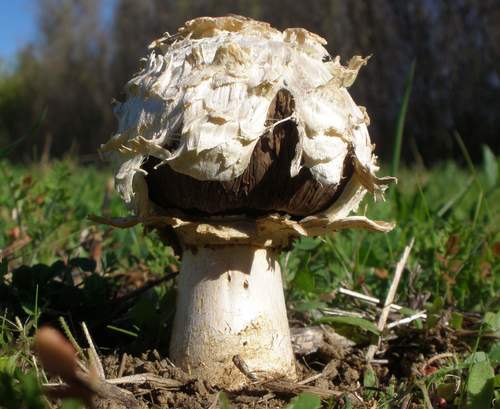
Agaricus deserticola is a saprobic desert mushroom species native to western and southwestern North America.
The fruit body of Agaricus deserticola reaches 5 to 18 cm (2 to 7 in) in height. Fresh specimens are typically white, fading to pale tan as they age, while dried fruit bodies are light gray or tan mixed with yellow. The cap measures 4 to 10 cm (1.5 to 4 in) in diameter; it starts out conical, and becomes convex to broadly convex as it matures. The cap is made of three distinct tissue layers: an ou...
View full details → 2
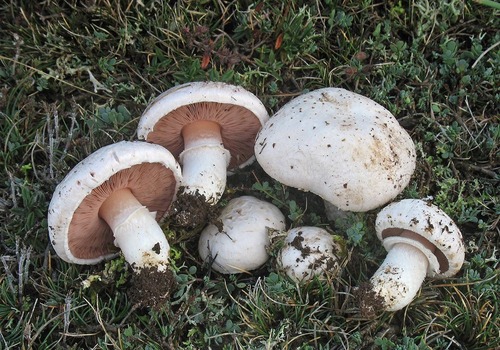
Agaricus campestris L. is a widely distributed wild edible mushroom with traditional and ongoing medical uses.
Agaricus campestris L. has a white cap that may bear fine scales, measuring 3 to 12 centimetres (1+1⁄4 to 4+3⁄4 inches) in diameter. When young, the cap is hemispherical, and it flattens out as it matures. Its gills start out pink, turn red-brown, and finally become dark brown; the spore print is also dark brown. The stipe grows 3 to 10 cm (1+1⁄4 to 4 in) tall and 1–2 cm wide, it is mostly white, ...
View full details → 3
Agaricus braendlei L.A.Parra & M.M.Gómez
Agaricus braendlei L.A.Parra & M.M.Gómez
🍄 Fungi Agaricaceae
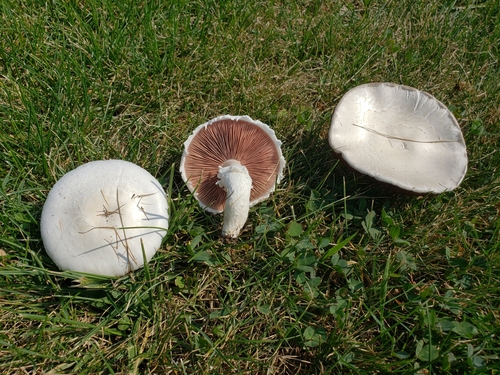
Agaricus braendlei is a popular edible North American mushroom in family Agaricaceae, closely related to A. campestris.
Agaricus braendlei is a species of mushroom belonging to the family Agaricaceae. It is found in North America, and is closely related to Agaricus campestris. Both species are popular edible mushrooms. They share these characteristics: white, slightly furry caps; bright pink gills that turn chocolate brown as spores mature; and no staining reaction when bruised or scratched. Like most species in th...
View full details → 4
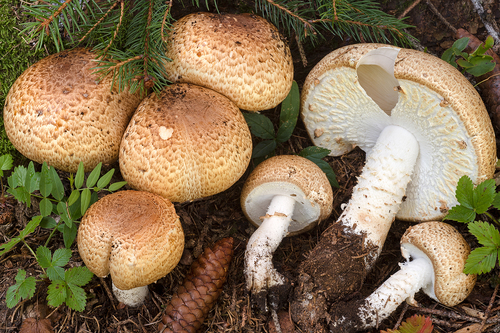
Agaricus augustus is a widespread choice edible mushroom that bioaccumulates cadmium.
Agaricus augustus Fr. produces large, distinctive agaric mushrooms. In the button stage, the cap is hemispherical; it expands as it grows, becoming convex before finally flattening out, and reaches 8–30 cm (3–12 in) in diameter. The dry cap cuticle has a white to yellow background, densely covered in concentrically arranged brown scales. The thick, firm, white flesh may turn yellow when bruised. T...
View full details → 5
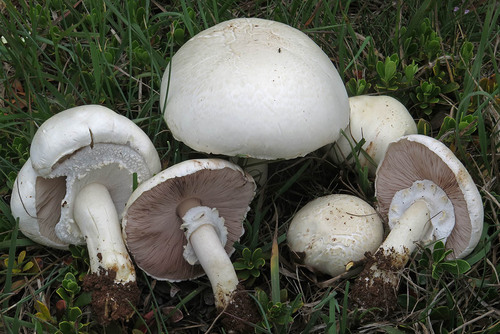
Agaricus arvensis Schaeff. is a large almond-scented white mushroom found across Britain, West Asia, and North America.
The cap of Agaricus arvensis Schaeff. measures 7–20 cm (3–8 in) across; it is whitish, smooth, and dry, and turns yellow when stained, especially when young. The gills are initially pale pink to white, then change color through grey and brown before becoming dull chocolate brown. This species has a large, spreading ring: the upper surface of the ring is white, while the underside sometimes bears y...
View full details → 6
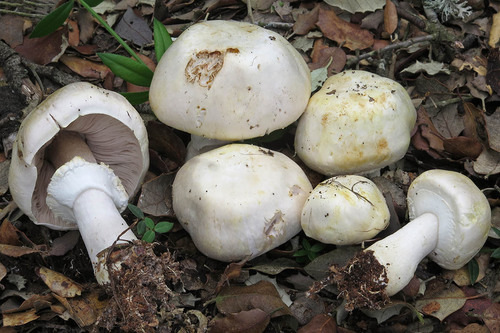
Agaricus sylvicola is an almond or anise-scented woodland mushroom found across Europe, North America, and South Asia.
The cap of Agaricus sylvicola is light cream, and bruises yellow ochre when damaged. It is 5–15 cm (2–6 in) in diameter, making it slightly smaller than its close relative A. arvensis. The stem is 5–15 cm (2–6 in) long, usually bulbous at the base, and matches the cap in color. It has a fragile drooping ring. The flesh is thin, white, and smells of almond or anise. Like other species in Agaricus s...
View full details → 7
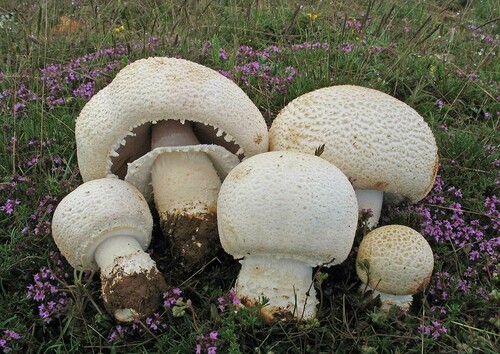
Agaricus crocodilinus Murrill is a saprophytic grassland mushroom that is generally considered edible but has notable safety risks.
This mushroom species, Agaricus crocodilinus Murrill, has a cap that starts round before becoming broadly convex. Young caps measure 5–12 centimetres (2–4+1⁄2 inches) across, while mature caps can reach 20–40 cm (8–15+1⁄2 inches) in width. Its stipe is 6–20 cm (2+1⁄4–7+3⁄4 inches) long, 2–4 cm (3⁄4–1+1⁄2 inches) wide, and bears a ring. The gills are free from attachment to the stipe; they start ou...
View full details → 8
Agaricus smithianus Kerrigan & L.A.Parra
Agaricus smithianus Kerrigan & L.A.Parra
🍄 Fungi Agaricaceae
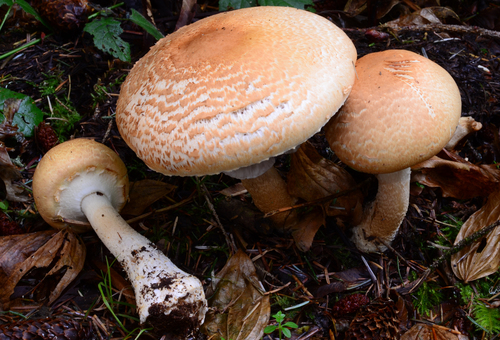
Agaricus smithianus is a mushroom species found in Pacific Northwest coastal conifer forests under Sitka spruce, with a distinct almond-like odor.
The cap of Agaricus smithianus is 5 to 20 centimetres (2 to 8 inches) wide. It begins with an ovate shape, and matures to become convex or flat. The cap is golden or brown, with a darker central disc. The stipe measures 5 to 12 cm (2 to 4 and 3⁄4 inches) tall and 2 to 3 cm (3⁄4 to 1 and 1⁄4 inches) wide; it has a ring, and is bulbous at the base. The gills are free from the stipe, and change color...
View full details → 9
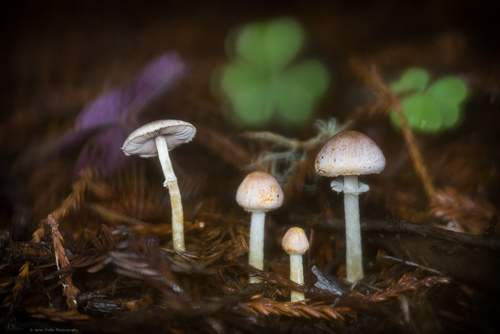
Agaricus diminutivus is a small, uncommon species complex mushroom not recommended for consumption, growing in conifer forests in autumn.
The cap of Agaricus diminutivus is around 1 to 3 centimeters in diameter. It starts out round or ovoid, maturing to become convex or flat. It is pale, most often whitish or tannish. The stipe is 2 to 6 centimeters long and 3 to 10 millimeters wide, with a ring that sometimes disappears as it ages. The gills are free from attachment to the stipe; they start pale pinkish tan, become pink as they dev...
View full details → 10
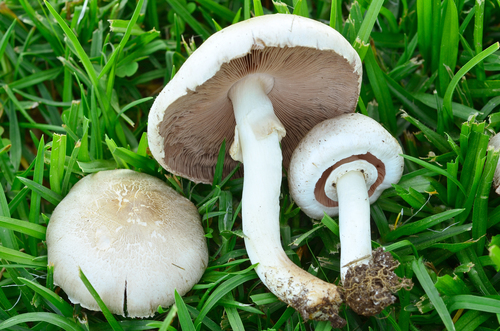
Agaricus californicus Peck is a mildly poisonous mushroom from Agaricus section Xanthodermati that typically causes gastrointestinal upset.
Agaricus californicus Peck has caps 5–12 cm (2.0–4.7 in) wide; the caps are white, sometimes with a grayish-tan center, and dry. They either stay unchanged or yellow slightly when bruised. The stalk is 3–10 cm (1.2–3.9 in) long and 1–2 cm wide, and may be larger at the base. It bears a persistent ring. Its spores are brown and smooth. Like many species in Agaricus section Xanthodermati, this speci...
View full details → 11
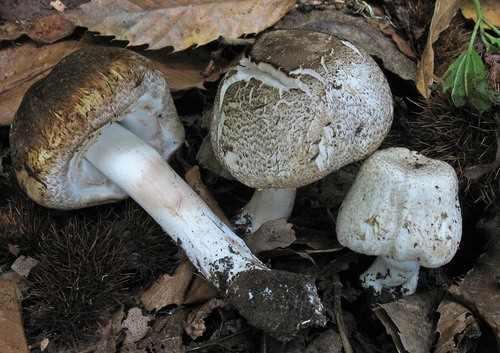
Agaricus moelleri is a Northern Hemisphere mushroom that bruises yellow and is considered toxic when eaten.
This species has the scientific name Agaricus moelleri Wasser. Its cap is off-white, with a greyish-brown patch at the centre and cold grey-brown scaling across the surrounding area. The cap measures 5 to 9 centimetres (2 to 3+1⁄2 inches) in diameter, turns yellow when bruised, is ovate when young, and flattens as it matures. The stem bears a drooping ring, stains yellow very easily when bruised, ...
View full details → 12
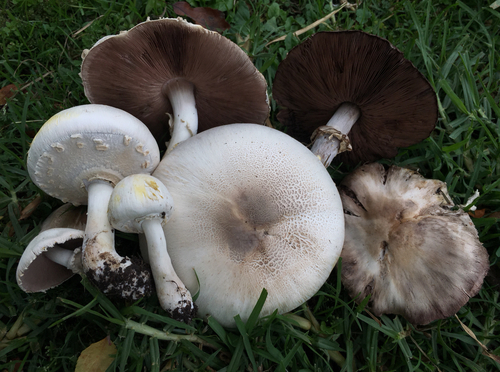
Agaricus xanthodermus Genev. is a poisonous common saprobic mushroom widely distributed across multiple continents.
Agaricus xanthodermus Genev. has a cap that is 5 to 15 centimeters (2 to 6 inches) in diameter. Young caps are initially convex, and some young specimens have a squarish shape; caps flatten as they age. The cap is whitish, with light brown coloring toward the center. It is dry and smooth, and may become scaly when the mushroom is old. The gills change color from pale-pink to chocolate brown as the...
View full details → 13
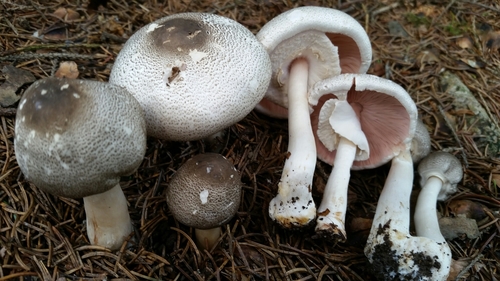
Agaricus placomyces is a phenol-odored mushroom found in North America that causes gastrointestinal upset in many people.
Agaricus placomyces Peck has a cap 5–13 centimetres (2–5 inches) wide, which changes shape from convex to broadly convex or nearly flat as it matures. The cap surface is dry, covered with brownish fibers and scales that are particularly concentrated over the center. The cap flesh is whitish in typical conditions, and may turn pinkish in wet weather. The cap is thick, covered in fine, appressed gre...
View full details → 14
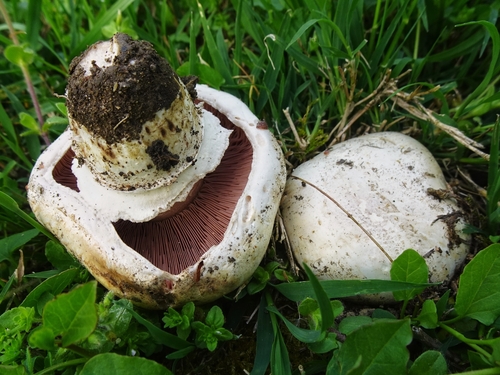
Agaricus bitorquis is a two-ringed mushroom found across multiple continents, cultivated as an alternative button mushroom with desirable growing traits.
The cap of Agaricus bitorquis is dry, smooth, and white, though it develops a yellowish stain as it ages. It measures 4 to 18 centimetres (1+1⁄2 to 7 inches) in diameter, with a shape ranging from convex to flat, and often has dirt present on its surface. The gills are free, very narrow, and closely spaced. They are light pink when young, and turn dark reddish-brown as spores mature. The spore pri...
View full details → 15
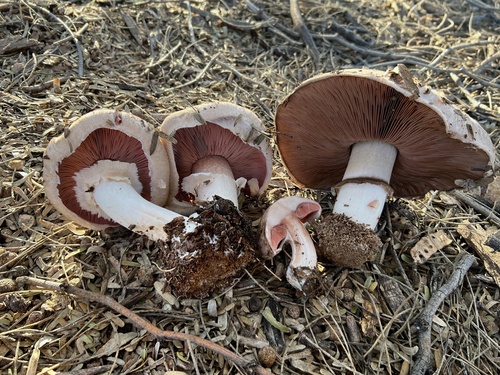
Agaricus bisporus is a widespread mushroom with defined morphological traits and specific habitat preferences.
The original wild Agaricus bisporus has a pale grey-brown pileus (cap), with broad, flat scales on a paler background that fade toward the cap margins. When young, the cap is hemispherical, and it flattens out as it matures. It typically measures 5–10 centimetres (2–4 inches) in diameter. The narrow, crowded gills are free from the stipe. They start out pink, then turn red-brown, and finally becom...
View full details → 16
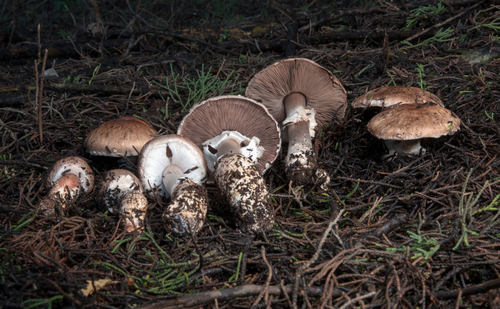
Agaricus brunneofibrillosus is an edible mushroom found in coastal California that bruises bright red when injured.
Agaricus brunneofibrillosus Kerrigan has a cap that starts convex before flattening, reaching a diameter of 5–13 cm (2–5 inches). The cap surface is dry and smooth, ranging in color from reddish-brown to coco-brown, with silky fibrils, sometimes flattened scales, and often a slight umbo. When the mushroom reaches maturity, the fibrils usually darken to walnut brown. The flesh is white and does not...
View full details → 17
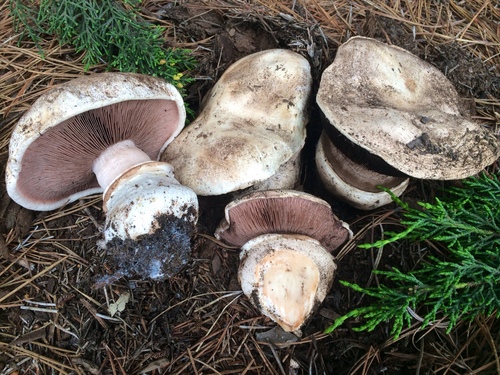
Agaricus bernardii is an edible salt-tolerant saprobic mushroom found across multiple continents that strongly bioaccumulates silver.
Fruit bodies of Agaricus bernardii have caps that range in shape from convex to flattened, reaching a diameter of 5–15 centimetres (2–6 inches). The cap surface is dry, smooth, and white or buff, and may develop brownish spots as it matures. Older fruit bodies often develop scales or warts on the cap surface. The flesh is thick and firm, and stains reddish-orange or reddish-brown when cut, though ...
View full details → 18
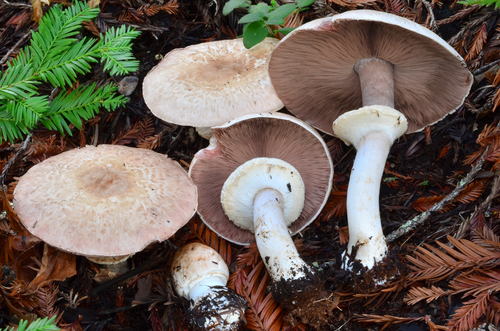
Agaricus hondensis is a toxic North American mushroom species that grows in Pacific coast forests.
Agaricus hondensis Murrill has a cap that starts globose, becomes convex, and sometimes flattens out at maturity, reaching a diameter of 6–15 cm (2+1⁄2–6 in). The cap surface is dry and smooth, whitish, or marked with pale pinkish-brown to pinkish-gray to fawn-colored flattened fibrils or fine fibrillose scales, most noticeably in the cap center. As the mushroom matures, these fibrils usually dark...
View full details → 19
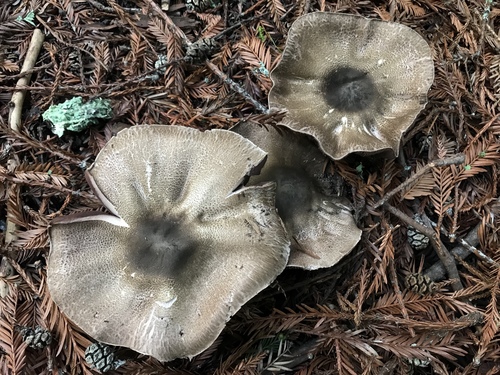
Agaricus buckmacadooi is a saprophytic mushroom that grows in North American Pacific coastal forests under conifers.
Agaricus buckmacadooi has a cap 8 to 20 centimeters in diameter, tannish brown and scaly. The cap starts out round or convex, and expands to become broadly convex or flat with growth. The stipe measures 7 to 15 centimeters long and 1 to 4 centimeters wide, and bears a ring. Its gills are free from the stipe, starting pale pink, turning pinkish tan, and becoming brown as the mushroom ages. The fles...
View full details → 20
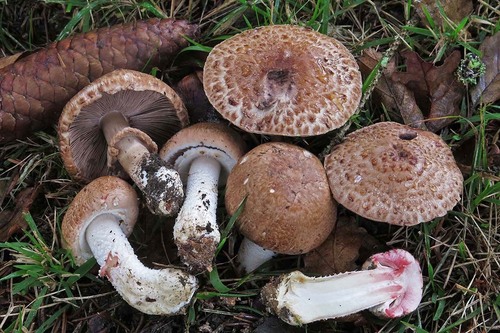
Agaricus sylvaticus Schaeff. is an edible brown-capped mushroom found in North American, European, and North African conifer forests.
Agaricus sylvaticus Schaeff. has a greyish-brown cap that is hemispherical when young, and flattens out as it matures, reaching up to 10 centimetres (4 inches) in diameter. The cap is covered with broad scales. Young gills are grey, and turn much darker as the mushroom ages. Its spores are chocolate brown. The brownish stem often has a hanging ring and a small bulb at the base. The flesh is white,...
View full details → 21
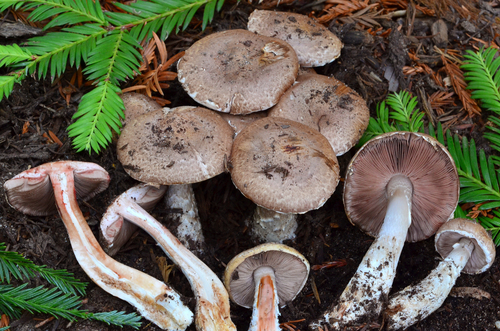
Agaricus arorae Kerrigan is a species of Agaricus found in three California counties with distinct macroscopic and microscopic features.
Agaricus arorae Kerrigan has a cap 3–7 centimetres (1+1⁄4–2+3⁄4 in) wide, which is convex when young before becoming flattened. Caps range in colour from white to reddish, with brownish fibrils or scales concentrated in the centre, and sometimes appearing across the rest of the cap. The cap surface yellows when treated with potassium hydroxide (KOH), and the flesh slowly bruises reddish when damag...
View full details → 22
Agaricus subrutilescens (Kauffman) Hotson & D.E.Stuntz
Agaricus subrutilescens (Kauffman) Hotson & D.E.Stuntz
🍄 Fungi Agaricaceae
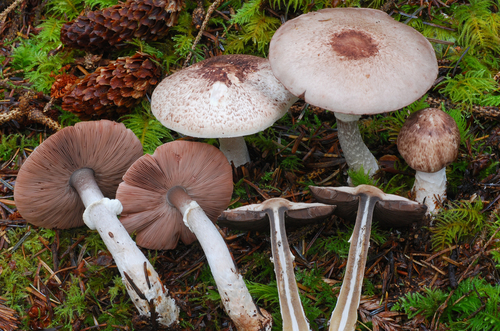
Agaricus subrutilescens is an agaric mushroom with a fibrillose wine-brown cap, found across North America, Asia, and Oceania.
Agaricus subrutilescens has a cap measuring 5–15 cm (2–6 in) across; the cap surface is dry and covered with numerous wine-colored to brown fibrils, which are most concentrated near the cap center. The gills are closely spaced: they start out white, turn pinkish as they mature, and become dark brown when the mushroom ages. The stalk is 4 to 20 cm (1+5⁄8 to 7+7⁄8 in) long, 1–3 cm (3⁄8–1+1⁄8 in) thi...
View full details → 23
Chlorophyllum molybdites (G.Mey.) Massee
Chlorophyllum molybdites (G.Mey.) Massee
🍄 Fungi Agaricaceae
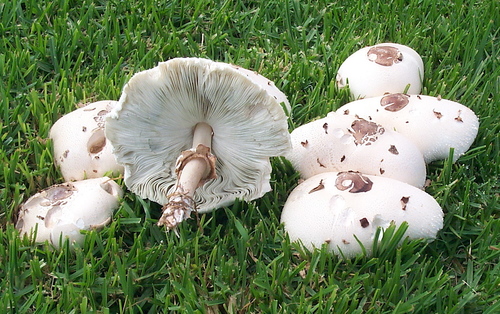
Chlorophyllum molybdites is a common green-spored poisonous mushroom frequently mistaken for edible species.
The pileus, or cap, of Chlorophyllum molybdites ranges from 8 to 30 cm (3.1 to 12 inches) in diameter; it is hemispherical with a flattened top. The cap is whitish, covered in coarse brownish scales. Its gills are free and white, usually turning dark green as the mushroom matures. This is the only large mushroom that produces a green spore print. The stipe grows from 5 to 30 cm (2.0 to 12 inches) ...
View full details → 24
Chlorophyllum rhacodes (Vittad.) Vellinga
Chlorophyllum rhacodes (Vittad.) Vellinga
🍄 Fungi Agaricaceae
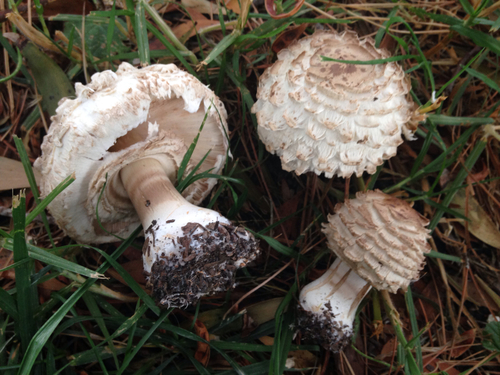
Chlorophyllum rhacodes, the shaggy parasol, is a large, conspicuous agaric mushroom with distinct physical traits.
This species, commonly called the shaggy parasol, is a large, easily noticeable agaric mushroom. Its fleshy white cap has thick brown scales and raised protruberances. Both the gills and spore print are white. The stipe is slender, uniformly colored with no patterns, and is bulbous at its base. It is fleshy; when cut, it develops a reddish or maroon discoloration and releases a pungent odor. Young...
View full details → 25
Chlorophyllum brunneum (Farl. & Burt) Vellinga
Chlorophyllum brunneum (Farl. & Burt) Vellinga
🍄 Fungi Agaricaceae
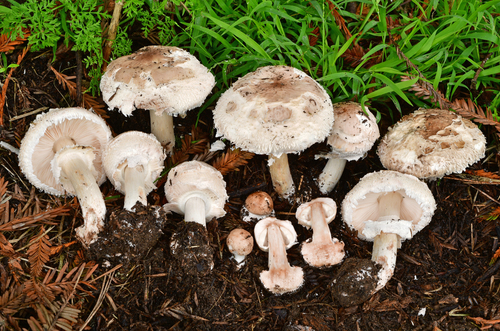
Chlorophyllum brunneum, the shaggy parasol, is a large, conspicuous agaric mushroom with distinct brown-scaled white caps.
Chlorophyllum brunneum, commonly called the shaggy parasol, is a large, noticeable agaric mushroom. Its fleshy white cap is covered in thick brown scales and raised bumps, and egg-shaped when young, becoming wider and flatter as it matures. Both the gills and spore print of this mushroom are white. Its stipe is slender, uniformly colored with no patterns, and has a bulbous base. When the mushroom ...
View full details → 26
Chlorophyllum hortense (Murrill) Vellinga
Chlorophyllum hortense (Murrill) Vellinga
🍄 Fungi Agaricaceae
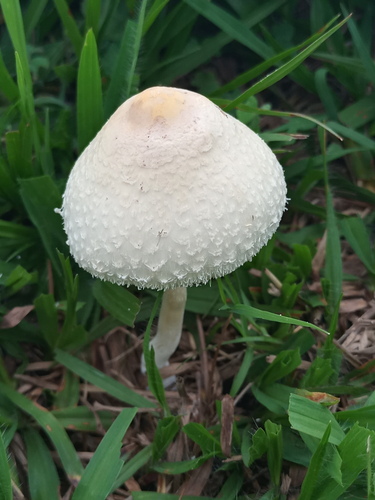
Chlorophyllum hortense is an agaric fungus found in Australia, North America, and China, first described from Alabama sandy soil.
Chlorophyllum hortense (Murrill) Vellinga has the following morphological characteristics. When mature, its cap measures 8 to 10 cm wide. It starts convex and slightly umbonate before expanding to its full size. The cap surface is dry, dirty yellowish-white, and covered in thread-like fibrillose filaments. The central disc of the cap is light brown, covered in large, light brown, woolly floccose s...
View full details → 27
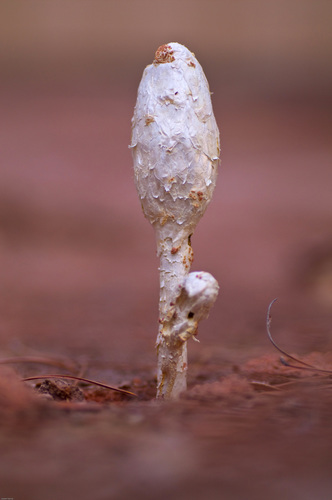
Podaxis pistillaris is a dry-environment fungus with traditional uses including pigmentation and dyeing.
This species' fruiting body has a pod-shaped cap that can grow up to 11 centimetres (4+1⁄4 inches) tall, paired with a hard, woody stem. The large cap protects the blackish spore-bearing tissue; it develops scales, splits open, and usually falls away entirely when the species reaches maturity, which allows wind to disperse the spores. When a spore print can be obtained, it is dark brown to black. ...
View full details → 28
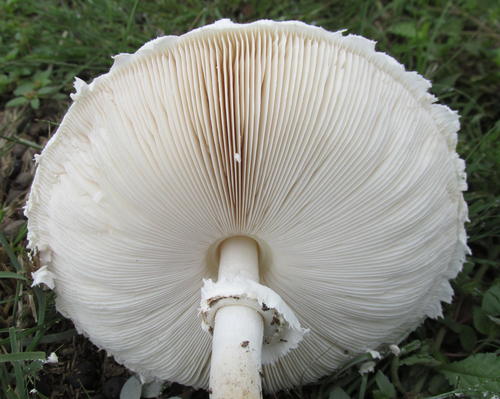
Macrolepiota zeyheri is a widespread Agaricaceae mushroom found in South Africa and the Democratic Republic of Congo.
Macrolepiota zeyheri Heinem. is a mushroom-forming fungal species belonging to the family Agaricaceae. It has two local common names: it is called djilo in the Kilendu dialect, and n'volo mighom in the Kilur dialect. The first specimens studied by Berkeley were collected during an expedition to South Africa, while Heinemann studied specimens collected from across the Democratic Republic of Congo. ...
View full details → 29
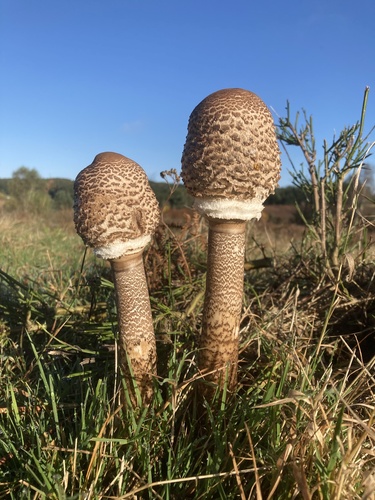
Macrolepiota procera is a popular, choice edible mushroom widespread across temperate Eurasia, with many common culinary preparations.
The scientific name of this fungus is Macrolepiota procera (Scop.) Singer. When immature, its cap is compact and egg-shaped, with the cap margin wrapping around the stipe to seal a chamber inside the cap. As the fungus matures, the cap margin breaks away, leaving a fleshy, movable ring around the stipe. Fully grown caps can reach up to 25 centimetres (10 inches) wide. When fully mature, the cap is...
View full details → 30
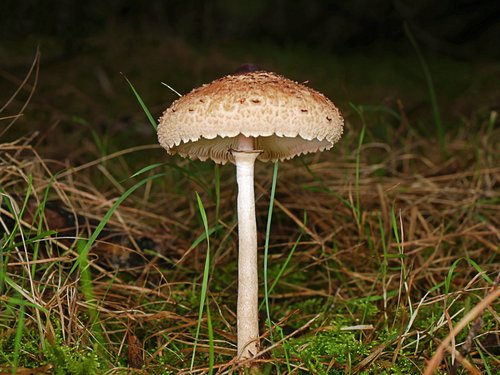
Macrolepiota clelandii is a mushroom species found in Australia and New Zealand with uncertain reported toxicity.
Macrolepiota clelandii Grgur. produces fruitbodies with caps that start egg-shaped, then become convex, and finally flatten when mature. Mature caps reach 7.6–12.5 cm (3.0–4.9 in) in diameter. The cap has a dark brown umbo, covered with small dark brown scales arranged in concentric rings that grow more dense toward the umbo; the dark brown scales reveal whitish flesh beneath. Small fragments of t...
View full details →Frequently Asked Questions
How many species are in the Agaricaceae family?
This guide features 30 representative species from the Agaricaceae family. The full family contains many more species worldwide — explore them all on iNature.
How to identify Agaricaceae species?
Agaricaceae species share common features in their flowers, leaves, and growth patterns. This guide provides photos and descriptions for 30 species. For instant field identification, use the iNature app.
Sources: GBIF, iNaturalist, Wikipedia · Disclaimer
Identify any species instantly — even offline
iNature uses on-device AI to identify plants, animals, fungi and more. No internet needed.
Download iNature — FreeStart Exploring Nature Today
Download iNature for free. 10 identifications on us. No account needed. No credit card required.
Download Free on App Store
